
How to Manage Multiple Marriage Halls and Branches from One System
Learn how multi-branch marriage hall management software can help venue owners control bookings, customer payments, staff, inventory, accounting and profitability across multiple halls and locations.
By Venue Khata ·
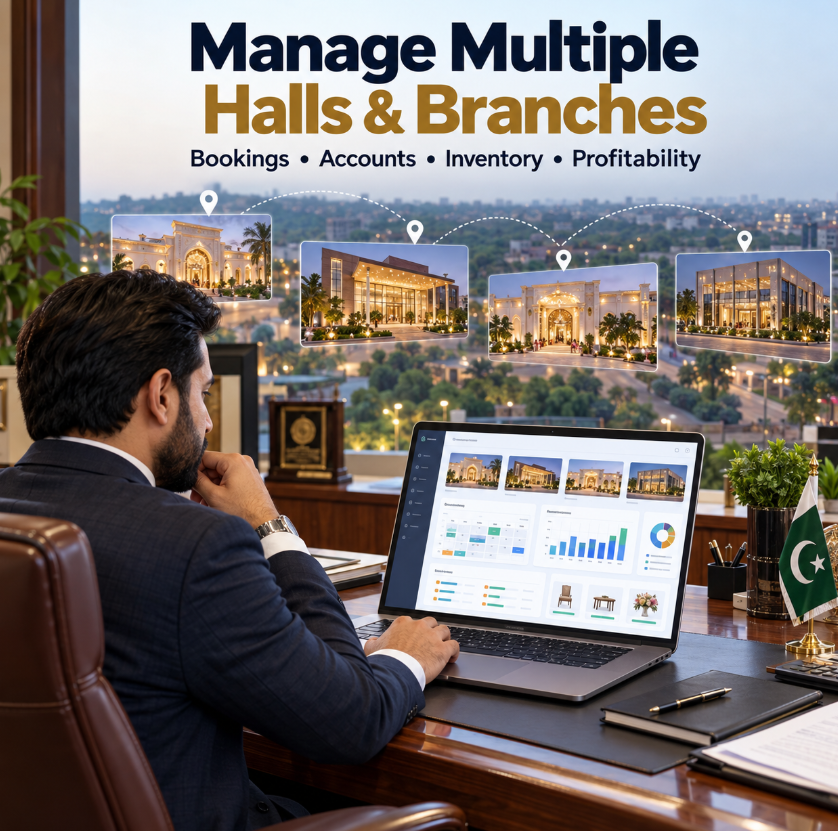
Managing one marriage hall can already involve dozens of moving parts.
Managing several halls or multiple branches makes the operation significantly more complex.
One location may have strong bookings.
Another may have weak collections.
One branch may be running low on inventory.
Another may have large supplier payables.
The owner may receive information through:
- WhatsApp messages
- Excel sheets
- Phone calls
- Printed reports
- Separate accounting files
By the time everything is combined, the information may already be outdated.
That is why growing venue businesses need a stronger approach to multi-branch marriage hall management.
The goal is not simply to give every branch its own software.
The real goal is to allow each location to operate independently while management can still see the wider business from one connected system.
This guide explains how marriage hall owners can manage multiple halls, venues and branches more effectively.
What Is Multi-Branch Marriage Hall Management?
Multi-branch marriage hall management means controlling several venue locations through one structured business system.
Each branch may maintain its own:
- Customers
- Quotations
- Bookings
- Halls
- Event schedules
- Payments
- Suppliers
- Inventory
- Employees
- Expenses
while authorized management can review the wider business.
For example:
A business may operate:
- Lahore branch
- Faisalabad branch
- Islamabad branch
Each location handles its own daily events.
But the owner may want to understand:
- Total bookings
- Customer receivables
- Supplier payables
- Inventory
- Revenue
- Expenses
- Event profitability
- Branch performance
from one place.
That is the main advantage of a centralized multi-branch system.
Why Multiple Locations Become Difficult to Manage Manually
A single-location business can often rely on direct owner involvement.
The owner can walk into reception.
They can check the register.
They can speak with accounts.
They can ask the kitchen.
This becomes harder when the business expands.
The owner cannot physically be present in several branches at once.
Information starts arriving through:
- Calls
- Messages
- Excel
- Printed statements
Now management depends on summaries created by different people.
This can lead to:
- Delayed information
- Different reporting formats
- Inconsistent numbers
- Duplicate data
- Weak oversight
A centralized system helps reduce these problems.
The Difference Between Multiple Halls and Multiple Branches
These are related but different.
Multiple Halls
A single property may have:
- Hall A
- Hall B
- Lawn
- Rooftop
- Banquet area
All of these belong to one location.
Multiple Branches
A business may operate:
- One property in Lahore
- Another in Faisalabad
- Another in Islamabad
Each branch may contain several halls.
The software should ideally support both structures.
For example:
Lahore Branch
- Grand Hall
- Royal Hall
- Lawn
Faisalabad Branch
- Marquee A
- Marquee B
This makes booking availability much clearer.
Why One Calendar Is Not Enough for Multiple Branches
A basic booking calendar may work for one venue.
But once the business expands, management needs more structure.
The system should understand:
- Branch
- Venue
- Date
- Start time
- End time
- Booking status
For example:
Lahore — Grand Hall — Confirmed
Lahore — Royal Hall — Available
Faisalabad — Marquee A — Tentative
Islamabad — Banquet Hall — Confirmed
This is much clearer than trying to fit every event into one long spreadsheet.
1. Centralize Booking Information
The first priority should be one centralized booking system.
Every branch should follow the same basic process.
For example:
Enquiry → Quotation → Tentative Booking → Confirmation → Event
This creates consistency.
Management should not have:
Lahore using Excel
while:
Faisalabad uses a paper register
and:
Islamabad uses WhatsApp
That creates reporting problems.
A centralized system gives the business one standard booking structure.
2. Keep Branch Availability Separate
Centralization does not mean mixing everything together.
Each branch still needs its own availability.
For example:
A customer asks:
Is your Lahore location available on 15 December?
The booking team should see only the relevant Lahore venues.
Another branch should not affect that availability.
The system should allow clear filtering by:
- Branch
- Venue
- Date
- Time
This prevents confusion.
3. Prevent Booking Conflicts Within Each Branch
Each branch may have several halls.
The system should help prevent overlapping bookings inside the same venue.
For example:
Lahore Branch
Grand Hall
Existing booking:
6:00 PM to 11:00 PM
A second employee attempts:
9:00 PM to 1:00 AM
The time overlaps.
A proper booking system should help identify the conflict.
Read How to Manage Marriage Hall Bookings Without Double Booking.
4. Use the Same Booking Statuses Across Branches
Every branch should use consistent status definitions.
For example:
- Enquiry
- Quotation
- Tentative
- Confirmed
- Rescheduled
- Cancelled
- Completed
Do not allow one branch to use:
Pending
while another uses:
Hold
for the same business meaning.
Consistent data makes management reporting much more useful.
5. Standardize Quotation Processes
Different branches should not create completely different quotation formats unless there is a valid business reason.
A central system can help standardize:
- Packages
- Menu structures
- Terms
- Discounts
- Customer information
Branches may still have different pricing.
But the overall quotation workflow should remain consistent.
This makes training and management easier.
6. Allow Branch-Specific Pricing Where Needed
Centralization does not mean every branch must charge exactly the same amount.
Costs may differ by city or location.
For example:
- Labour costs
- Supplier prices
- Venue positioning
- Local demand
may vary.
Therefore, software should support consistent structure while still allowing authorized branch-specific pricing.
The important thing is visibility.
Management should know what each branch is charging.
7. Control Discounts Across Branches
Discounting becomes harder to control as the business expands.
One branch may follow pricing discipline.
Another may regularly offer large discounts to close bookings.
This can make revenue look strong while margins fall.
A better process may include:
- Discount limits
- Manager approval
- Owner approval for exceptional cases
- Recorded reasons
Historical profitability can then show whether discounts are helping or hurting.
8. Centralize Customer Records
A customer may contact more than one branch.
For example:
A family may first visit the Lahore location.
Later, they decide Faisalabad is more convenient.
If every branch has completely separate customer records, staff may not know about the previous enquiry.
A centralized customer system can help provide continuity.
Useful information may include:
- Customer details
- Enquiry history
- Quotations
- Bookings
- Payments
Access should still follow appropriate permissions.
9. Track Customer Payments by Branch
Every customer collection should be linked with the correct:
- Customer
- Booking
- Branch
- Venue
This becomes especially important for financial reporting.
Management may want to know:
- Lahore customer receivables
- Faisalabad customer receivables
- Islamabad customer receivables
Without branch identification, these reports become difficult.
10. Monitor Outstanding Customer Balances by Location
One branch may have strong collections.
Another may have large outstanding balances.
For example:
Lahore outstanding: Rs. 2,500,000
Faisalabad outstanding: Rs. 5,000,000
Islamabad outstanding: Rs. 1,800,000
This information can reveal where collection processes need improvement.
Read How to Track Outstanding Payments from Marriage Hall Customers.
11. Keep Security Deposits Branch-Specific
Refundable customer deposits should also remain connected with the correct branch.
Management should know:
- Which branch received the deposit?
- Which customer?
- Which event?
- Has it been refunded?
- Is it still being held?
This is particularly important if each branch maintains separate cash or bank accounts.
Read How to Manage Customer Advances and Security Deposits in Marriage Halls.
12. Maintain Separate Branch Cash Accounts
Each branch may maintain its own cash activity.
The accounting system should make it possible to understand:
- Cash received
- Cash paid
- Current cash position
for each location.
This gives management better control.
Without branch-level accounting, cash differences can become difficult to investigate.
13. Maintain Branch-Specific Bank Accounts Where Applicable
Some businesses may use separate bank accounts for different branches.
Others may use centralized accounts.
The accounting structure should reflect the actual business process.
The important thing is that every transaction should have a clear branch and financial reference.
This supports reconciliation.
14. Track Suppliers by Branch
Branches may use different suppliers.
For example:
The Lahore branch may buy meat from Supplier A.
The Faisalabad branch may use Supplier B.
The system should be able to show:
- Branch
- Supplier
- Purchases
- Payments
- Outstanding balance
This creates better supplier visibility.
15. Identify Shared Suppliers
Some suppliers may serve several branches.
For example:
One beverage supplier may provide stock to all locations.
Management may want to understand:
- Total purchasing volume
- Branch-level purchasing
- Supplier balance
This can also strengthen supplier negotiations.
A business purchasing larger combined volumes may be able to negotiate better pricing.
16. Track Supplier Payables by Branch
Supplier liabilities should not become mixed together without context.
For example:
Lahore payable: Rs. 1,200,000
Faisalabad payable: Rs. 900,000
Islamabad payable: Rs. 600,000
Management can then see which location has the greatest financial obligation.
This is important for cash-flow planning.
17. Maintain Inventory by Location
Inventory should usually remain branch-specific.
A bag of rice physically located in Lahore cannot automatically serve an event in Faisalabad.
The system should know where inventory exists.
For example:
Lahore Branch
Rice: 500 kg
Faisalabad Branch
Rice: 250 kg
This gives management a realistic stock picture.
18. Avoid Combining All Inventory Into One Number
If the system only says:
Total rice stock: 750 kg
that may not be operationally useful.
If Faisalabad needs 350 kg tomorrow, the total company stock looks sufficient.
But that branch only has 250 kg.
Location-specific inventory is essential.
19. Record Branch Transfers Properly
Sometimes one branch may transfer inventory to another.
For example:
Lahore sends beverages to Faisalabad.
This should not simply disappear from one stock record and appear in another.
A structured transfer process should show:
- Source branch
- Destination branch
- Item
- Quantity
- Date
This improves accountability.
20. Compare Food Cost Across Branches
Different branches may have different food costs.
Management may discover:
Lahore average food cost: lower
Faisalabad average food cost: higher
Now the owner can investigate.
Possible reasons include:
- Supplier prices
- Wastage
- Portion control
- Different menus
- Purchasing practices
Multi-branch reporting can reveal these patterns.
21. Compare Supplier Prices Across Locations
A centralized system can help management understand purchasing differences.
For example:
One branch may pay a significantly higher price for the same ingredient.
That may be justified.
But management should know about it.
This can support:
- Supplier negotiation
- Central purchasing
- Better procurement decisions
22. Manage Employees by Branch
Employees should remain associated with their location.
For example:
Lahore Branch
- Manager
- Accountant
- Front-desk staff
- Kitchen staff
Faisalabad Branch
- Manager
- Accountant
- Event team
This makes employee reporting clearer.
23. Manage Attendance by Branch
Attendance should also remain location-specific.
Management may want to review:
- Staff presence
- Working days
- Attendance issues
for each branch.
This becomes important for payroll and staff planning.
24. Manage Payroll by Branch
Payroll is a major operating cost.
The system should make it possible to understand payroll by location.
For example:
Lahore payroll: Rs. 1,500,000
Faisalabad payroll: Rs. 900,000
This helps management compare operating costs.
25. Use Branch-Level User Permissions
A receptionist at one location may not need access to another branch.
For example:
Faisalabad Reception
Can manage:
- Faisalabad enquiries
- Faisalabad bookings
- Faisalabad customers
but not:
- Lahore accounting
- Islamabad payroll
This reduces unnecessary access.
26. Give Owners Wider Access
Senior management may need broader visibility.
The owner or head office may need:
- All branches
- Consolidated reports
- Branch comparisons
- Financial overview
- Event profitability
This creates the right balance between branch independence and central control.
27. Separate Operational Access From Financial Access
Branch employees should not automatically receive full accounting access.
For example:
Front Desk
Needs:
- Customers
- Quotations
- Bookings
Accounts
Needs:
- Receipts
- Payments
- Ledgers
- Reports
Operations
Needs:
- Event details
- Guest counts
- Menus
Head Office
May need wider visibility.
Role-based permissions become increasingly important as the company grows.
28. Track Event Profitability by Branch
One of the most useful multi-branch reports is profitability by location.
Management can compare:
- Revenue
- Direct event costs
- Event contribution
across branches.
For example:
One location may have more bookings.
Another may have stronger margins.
The busiest branch is not automatically the most profitable branch.
29. Compare Event Profitability Across Venues
Even within one branch, individual halls may perform differently.
For example:
Grand Hall
Higher booking value but higher operating costs.
Royal Hall
Lower revenue but stronger contribution.
This can guide:
- Pricing
- Package design
- Sales strategy
Venue Khata's event profitability functionality supports event-level financial analysis.
30. Compare Branch Revenue Carefully
Revenue comparison alone can be misleading.
Suppose:
Branch A revenue: Rs. 20 million
Branch B revenue: Rs. 15 million
Branch A appears stronger.
But Branch A may also have:
- Higher food cost
- Higher payroll
- More discounts
- Larger overhead
Management should compare revenue together with cost and profitability.
31. Monitor Customer Receivables by Branch
A high-revenue branch may still have weak collections.
For example:
Branch A sales: Rs. 20 million
but:
Outstanding customer balance: Rs. 8 million
That creates cash-flow risk.
Receivables should be reviewed by branch as well as company-wide.
32. Monitor Supplier Payables by Branch
The same applies to supplier obligations.
One branch may generate strong revenue but also carry high supplier debt.
Management should review:
- Customer receivables
- Supplier payables
- Cash
- Bank
together.
This provides a more realistic financial picture.
33. Use Standard Reports Across All Branches
Every branch should not create its own reporting format.
For example, if Lahore reports:
Monthly Sales
while Faisalabad reports:
Gross Booking Value
the numbers may not be directly comparable.
A centralized system creates common definitions.
This improves management reporting.
34. Standardize Accounting Structure
Using the same chart-of-accounts structure across locations can make consolidated reporting easier.
For example, every branch uses consistent categories for:
- Revenue
- Food expense
- Salaries
- Utilities
- Marketing
- Repairs
This does not mean every branch has identical activity.
It means reports follow the same financial language.
Your accountant should define the final accounting structure appropriate for the business.
35. Keep Branch-Level Financial Statements
Management may want to understand each location independently.
Useful branch-level reports can include:
- Income statement
- Receivables
- Payables
- Cash position
- Inventory
- Payroll
This helps identify strong and weak areas.
36. Review Consolidated Company Reports
Branch-level information is important.
But the owner also needs the full company picture.
A consolidated view can help answer:
- Total revenue
- Total expenses
- Total receivables
- Total payables
- Overall financial position
This becomes increasingly important as the organization grows.
Explore Venue Khata reports.
37. Create Branch Performance Reviews
Management can review each location regularly.
A useful review can include:
- Number of bookings
- Booking value
- Customer collections
- Outstanding balances
- Supplier payables
- Food cost
- Payroll
- Event contribution
This provides a balanced view.
38. Do Not Rank Branches Only by Booking Count
One branch may handle more events because it has:
- Smaller halls
- Lower prices
- More weekday demand
Another branch may handle fewer events but produce stronger revenue and contribution.
Therefore, booking count alone is not enough.
Branch performance should be reviewed using several financial and operational indicators.
39. Track Discounts by Branch
One branch may consistently offer more discounts.
Management should know:
- Discount amount
- Reason
- Approver
- Effect on pricing
High discounting can hide inside strong booking numbers.
Branch comparisons can reveal this.
40. Track Cancellation Rates
Branches may also differ in booking quality.
One branch may have:
- Strong confirmations
- Low cancellations
Another may have:
- Many tentative bookings
- High cancellation rates
Tracking this helps improve sales processes.
41. Track Rescheduling
Frequent rescheduling can create operational issues.
Management may want to understand whether one location experiences unusually high changes.
Possible causes could include:
- Customer type
- Booking policies
- Seasonal patterns
- Sales practices
Data helps identify these trends.
42. Use One Customer-Service Standard
Multi-branch businesses should try to give customers a consistent experience.
That can include:
- Quotation format
- Payment policy
- Receipt format
- Booking status
- Deposit handling
- Cancellation process
Consistency strengthens the brand.
Customers should not feel that each branch belongs to a completely different company.
43. Keep Local Flexibility
Standardization is important.
But branches may still need some flexibility.
For example:
- Local menus
- Local suppliers
- City-specific pricing
- Branch-specific packages
The best system allows standardized control without forcing every location to operate identically.
44. Avoid Managing Branches Through WhatsApp Alone
WhatsApp is useful for communication.
But it should not become the company's reporting platform.
Messages such as:
Lahore sales today: Rs. 500,000
or:
Faisalabad has 12 bookings next week
are helpful updates.
But they are not a substitute for structured records.
The underlying business information should remain in the central system.
45. Avoid Daily Excel Consolidation
Some multi-branch businesses follow this process:
Each branch prepares Excel.
Head office receives files.
Someone combines them.
Management reviews the consolidated file.
This works.
But it creates repeated work.
It can also result in:
- Different versions
- Formula errors
- Reporting delays
- Inconsistent categories
A central system can reduce this manual consolidation.
46. Create a Daily Management Dashboard
A multi-branch owner may want a quick daily view.
Useful information can include:
- Today's events
- Upcoming bookings
- Collections
- Major outstanding balances
- Branch cash position
The dashboard should highlight areas requiring attention.
It should not overwhelm management with every transaction.
47. Create a Weekly Branch Review
Every week, management can review:
- Bookings
- Tentative holds
- Customer receivables
- Supplier payables
- Inventory issues
- Large expenses
This helps identify operational problems early.
48. Create a Monthly Branch Review
Monthly review can go deeper.
Focus on:
- Revenue
- Expenses
- Payroll
- Inventory
- Customer receivables
- Supplier payables
- Event profitability
- Financial statements
The goal is not only to see which branch sold more.
The goal is to understand which branch is operating well.
49. Use Branch Data to Improve Pricing
Historical data can show whether each location's pricing is appropriate.
For example:
One city may have:
- Higher ingredient costs
- Higher labour cost
That branch may require different pricing.
Another branch may have stronger demand and room for higher rates.
Data can support these decisions.
50. Use Branch Data to Improve Procurement
If several branches buy the same products, management can compare prices.
This may reveal opportunities for:
- Central supplier agreements
- Volume discounts
- Better purchasing terms
Multi-branch visibility creates negotiating power.
51. Use Branch Data to Improve Staffing
Management can compare:
- Payroll
- Booking volume
- Event volume
across branches.
One branch may be overstaffed.
Another may need more employees.
This supports better workforce planning.
52. Use Branch Data to Identify Strong Managers
Branch performance is affected by local management.
Over time, company-wide data may help identify locations with consistently strong:
- Collections
- Cost control
- Customer service
- Profitability
Management can then study what those branches are doing well.
The goal should be to share strong practices across the organization.
Common Multi-Branch Management Mistakes
Mistake 1: Giving Every Branch a Different System
Standardize the core workflow.
Mistake 2: Combining All Inventory
Keep stock location-specific.
Mistake 3: Looking Only at Revenue
Review costs and profitability too.
Mistake 4: Ignoring Customer Receivables
High bookings do not guarantee strong cash flow.
Mistake 5: Ignoring Supplier Payables
Cash balance alone is misleading.
Mistake 6: Giving Everyone Access to Every Branch
Use role-based permissions.
Mistake 7: Reporting Through WhatsApp Only
Use structured system data.
Mistake 8: Manually Combining Excel Files Forever
Centralize reporting as the company grows.
Mistake 9: Using Different Definitions at Each Branch
Standardize reporting terms.
Mistake 10: Expanding Before Processes Are Stable
A weak process becomes harder to manage when copied across branches.
When Is Your Venue Business Ready for Multi-Branch Software?
Multi-branch functionality becomes increasingly valuable when:
- You operate several locations
- Each location has several halls
- Owners cannot be physically present everywhere
- Branches maintain separate accounting files
- Reports are manually consolidated
- Customer balances are difficult to compare
- Inventory is managed separately
- Management wants branch-level profitability
The larger the organization becomes, the greater the value of connected data.
How to Move Multiple Branches Into One System
Do not migrate every branch randomly.
Use a controlled process.
Step 1: Standardize Processes
Agree on:
- Booking statuses
- Customer-payment rules
- Discount approvals
- Supplier workflows
Step 2: Configure Branches
Create all locations and halls correctly.
Step 3: Configure Users
Assign employees to the appropriate branches.
Step 4: Clean Data
Review customers, suppliers and balances.
Step 5: Move Upcoming Bookings
Future events are usually the highest priority.
Step 6: Enter Opening Financial Balances
Work with your accounting team.
Step 7: Start One Standard Workflow
Choose a clear implementation date.
Step 8: Review Branch Adoption
Make sure employees are actually using the system consistently.
Should Every Branch Go Live on the Same Day?
Not necessarily.
A growing company may prefer a phased rollout.
For example:
Phase 1
Implement the strongest branch first.
Phase 2
Review problems and improve the process.
Phase 3
Roll out to additional branches.
This can reduce implementation risk.
However, avoid running different permanent systems across branches for too long.
The goal should eventually be one consistent structure.
How Venue Khata Supports Multi-Branch Venue Management
Venue Khata is designed for marriage halls, marquees and banquet venues that need connected operational and financial workflows.
For growing venue businesses, the wider system can help organize:
- Multiple venues
- Bookings
- Customer payments
- Accounting
- Suppliers
- Inventory
- Payroll
- Reports
- Event profitability
Multi-branch management allows the business to maintain location-specific operations while giving authorized management broader visibility.
Explore the full Venue Khata features.
Why Venue Khata Booking Management Matters Across Branches
A multi-branch business needs reliable venue availability.
The system should identify:
- Branch
- Hall
- Date
- Time
- Booking status
Venue Khata's marriage hall booking software helps organize these booking workflows.
This reduces dependence on calls between locations.
Why Venue Khata Accounting Matters Across Branches
The owner also needs financial visibility.
Important areas include:
- Customer ledgers
- Supplier ledgers
- Receivables
- Payables
- Cash
- Bank
- Financial reporting
Venue Khata's marriage hall accounting software helps connect financial records with venue operations.
Read our Complete Guide to Marriage Hall Accounting in Pakistan.
Why Event Profitability Matters Across Branches
One branch may generate more sales while another generates better contribution.
Event profitability gives management another way to evaluate performance.
Read How to Calculate the Real Profit of Every Marriage Hall Event.
The same principle can be used when comparing branch performance.
Five Numbers Multi-Branch Owners Should Know
Management should regularly know:
1. Booking Value by Branch
How much future business does each branch have?
2. Customer Receivables by Branch
How much do customers owe each location?
3. Supplier Payables by Branch
How much does each branch owe?
4. Event Contribution by Branch
How are individual events performing?
5. Overall Company Performance
What does the complete business look like after combining locations?
These figures provide much stronger oversight than branch booking counts alone.
Related Guides
Continue improving your venue-management system with these Venue Khata guides:
- Best Marriage Hall Management Software in Pakistan
- Marriage Hall Management Software Features Every Hall Owner Needs
- How to Manage Marriage Hall Bookings Without Double Booking
- Marriage Hall Booking Software vs Excel
- Complete Guide to Marriage Hall Accounting in Pakistan
- How Marriage Hall Accounting Software Simplifies Daily Accounts
- Why Fully Booked Marriage Halls Can Still Lose Money
- How to Digitize a Marriage Hall Business in Pakistan
- Paper Registers vs Marriage Hall Management Software
- How to Manage Customer Advances and Security Deposits in Marriage Halls
- How to Track Outstanding Payments from Marriage Hall Customers
Final Thoughts
Opening another marriage hall or branch creates opportunity.
It also creates complexity.
The owner can no longer depend on:
- Walking to reception
- Checking one register
- Asking one accountant
- Reviewing one inventory store
The business needs a system that can keep each location organized while still giving management a wider view.
A strong multi-branch marriage hall system should help answer:
- What is booked at each branch?
- What venues are available?
- What do customers owe?
- What do suppliers need to be paid?
- What inventory exists at each location?
- What does payroll cost?
- Which events perform well?
- Which branches are financially stronger?
The goal is not to control every small decision from head office.
The goal is to give each branch the tools to operate properly while giving management accurate information.
That is the difference between simply owning several venues and running a connected multi-branch venue business.
Explore Venue Khata to see how bookings, accounting, inventory, customer balances and event profitability can work together across growing marriage hall, marquee and banquet operations.
Frequently Asked Questions
What is multi-branch marriage hall management software?
It is software that allows several venue locations to manage their own bookings and operations while authorized management can review information across the wider business.
Can one system manage multiple marriage halls?
Yes. A multi-venue system can organize separate locations, halls, bookings, users and financial records within one broader platform.
Can different branches have different halls?
Yes. Each location can contain its own bookable venues, such as marriage halls, marquees, lawns or banquet spaces.
Can branch staff see only their own location?
A system with role-based permissions can restrict users to the branches and functions they are authorized to access.
Can an owner see all branches?
Authorized management users can be given wider access so they can review several locations and company-wide reports.
How should inventory be managed across branches?
Inventory should generally remain location-specific because stock physically exists at a particular branch. Transfers between branches should be recorded properly.
Can customer outstanding balances be tracked by branch?
Yes. Payments and bookings should remain associated with the relevant location so receivables can be reviewed branch by branch.
Can supplier balances be tracked by branch?
Yes. Supplier purchases, payments and outstanding balances can be associated with the relevant branch.
Why is branch-level profitability important?
A branch may have higher revenue but also higher costs. Profitability analysis provides a stronger view than booking count or sales alone.
Should every branch use the same pricing?
Not necessarily. Branches can have different pricing where justified, but management should maintain a consistent pricing and approval structure.
Is WhatsApp enough for managing multiple branches?
WhatsApp is useful for communication but is not a substitute for centralized booking, accounting and reporting records.
Can Venue Khata manage multiple branches?
Venue Khata is designed to support multi-branch and multi-venue workflows so growing venue businesses can organize branch operations while maintaining broader management visibility.
Can Venue Khata manage branch-level accounting?
Venue Khata's connected accounting workflows allow financial activity to remain associated with the appropriate business structure while providing broader reporting to authorized management.
Can Venue Khata help compare branch performance?
Connected booking, accounting, reporting and event-profitability information can provide management with stronger visibility into how different locations are performing.