
How to Manage Customer Advances and Security Deposits in Marriage Halls
Learn how marriage halls can manage customer advances, installment payments, outstanding balances and refundable security deposits with clearer booking and accounting controls.
By Venue Khata ·
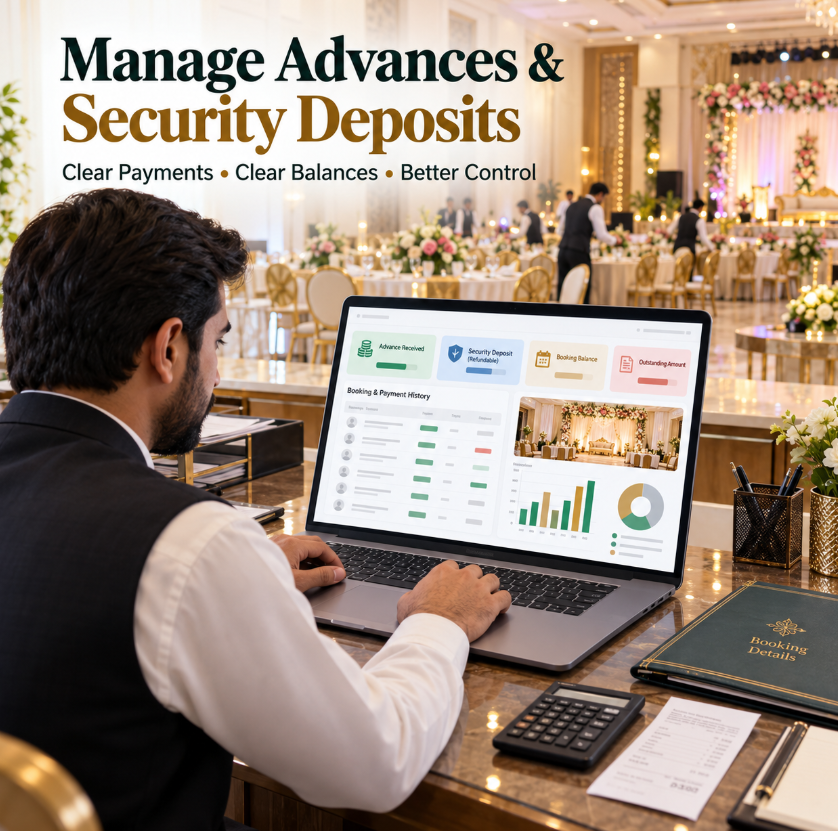
Customer payments are one of the most sensitive parts of running a marriage hall.
A customer may book an event months before the actual function.
During that period, they may pay:
- An initial booking advance
- A second installment
- Another payment before the event
- A final settlement
- A separate refundable security deposit
If these payments are not recorded clearly, problems can appear very quickly.
Reception may show one balance.
Accounts may show another.
The customer may claim they already paid.
The security deposit may accidentally be treated as revenue.
A refund may be forgotten.
This is why marriage halls need a clear process for customer advances and security deposits.
The goal is simple:
Every payment should have a clear purpose, clear history and clear balance.
This guide explains how Pakistani marriage halls, marquees and banquet venues can manage customer advances, outstanding balances and refundable deposits more accurately.
What Is a Customer Advance?
A customer advance is money received before the full event service has been completed.
For example:
Total booking value: Rs. 900,000
The customer confirms the booking by paying:
Rs. 200,000 advance
The venue has received part of the total amount.
The remaining balance is:
Rs. 700,000
Later, the customer may make more payments.
For example:
Second payment: Rs. 250,000
Now the total received becomes:
Rs. 450,000
Remaining balance:
Rs. 450,000
A good booking and accounting system should make this position easy to understand.
What Is a Security Deposit?
A security deposit is different from a normal customer advance.
It is usually money held temporarily by the venue to protect against certain risks.
Depending on the venue's policy, this may relate to:
- Property damage
- Equipment damage
- Extra cleaning
- Unapproved overtime
- Other agreed conditions
If no deduction is required, the deposit may be refunded after the event.
This is why a refundable deposit should not simply be mixed with ordinary booking revenue.
Customer Advance vs Security Deposit
These two amounts serve different purposes.
Customer Advance
Usually forms part of the customer's event payment.
It reduces the outstanding booking balance.
Security Deposit
Usually remains separately identifiable because it may need to be refunded.
For example:
Event value: Rs. 800,000
Booking advance: Rs. 200,000
Security deposit: Rs. 50,000
The customer may have physically paid:
Rs. 250,000
But the booking advance is still only:
Rs. 200,000
The Rs. 50,000 deposit should remain separate.
That distinction is extremely important.
Why Marriage Halls Struggle With Advance Payments
The problem is rarely receiving the payment.
The problem is maintaining accurate records over several months.
A single customer may:
- Pay through cash
- Pay through bank transfer
- Pay several installments
- Change the event value
- Increase the guest count
- Add services
- Receive a refund
- Pay a security deposit
If each change is recorded in a different place, staff may lose track of the true customer balance.
Why One Payment Register Is Often Not Enough
Many venues maintain one manual payment register.
That may show:
- Customer name
- Amount
- Date
But management also needs to know:
- Which booking?
- Which branch?
- Was it an advance?
- Was it a deposit?
- Was it a final payment?
- Was it cash or bank?
- What is the remaining balance?
A simple receipt entry does not answer all of these questions.
A structured system should connect the payment with the customer and event.
1. Define Your Booking Advance Policy
Before using any software, define the business rule.
For example:
A venue might require:
25% booking advance to confirm the event
or:
Rs. 200,000 minimum advance
The exact amount depends on the business.
What matters is consistency.
Staff should know:
- What is required to confirm?
- Is the advance refundable?
- Under what conditions?
- When is the next installment due?
These rules should be communicated clearly to customers.
2. Define When a Booking Becomes Confirmed
This is important.
One employee may think a booking is confirmed when the customer verbally says yes.
Another may think it is confirmed only after payment.
That can create scheduling problems.
A clearer rule is:
Quotation Accepted + Required Advance Received = Confirmed Booking
Your process may differ, but it should be clearly defined.
This reduces confusion between front desk and accounts.
3. Record Every Payment Against the Correct Customer
Every customer receipt should identify:
- Customer
- Booking
- Amount
- Date
- Payment method
- Payment purpose
This creates a proper financial trail.
Avoid generic entries such as:
Received Rs. 100,000
That amount should always have business context.
4. Keep Payment History
Do not overwrite previous payments.
A customer may pay four installments.
The system should preserve all four.
For example:
First payment: Rs. 200,000
Second payment: Rs. 150,000
Third payment: Rs. 250,000
Final payment: Rs. 300,000
This makes it easy to answer customer questions.
It also helps during financial reconciliation.
5. Calculate Outstanding Balance Automatically
The outstanding amount should be easy to understand.
A simple structure is:
Final Event Charges
minus
Customer Payments
equals
Outstanding Balance
For example:
Final charges: Rs. 1,000,000
Payments received: Rs. 650,000
Outstanding: Rs. 350,000
Staff should not need to use a calculator every time the customer calls.
A connected system should maintain the balance from recorded transactions.
6. Do Not Mix Security Deposits With Customer Advances
This is one of the most important rules.
Suppose a customer pays:
Rs. 300,000 event advance
plus:
Rs. 50,000 security deposit
Do not record:
Customer advance = Rs. 350,000
if the deposit is refundable and separate.
Instead maintain:
Advance toward booking: Rs. 300,000
Security deposit held: Rs. 50,000
This creates a much clearer financial position.
7. Create a Separate Security Deposit Workflow
A good process may look like:
Deposit Required
↓
Deposit Received
↓
Deposit Held
↓
Event Completed
↓
Deposit Reviewed
↓
Refunded or Adjusted
Each stage should be clear.
This helps staff know whether the deposit is still being held or has already been returned.
8. Record the Deposit Payment Method
Security deposits may be received through:
- Cash
- Bank transfer
- Other approved methods
The system should preserve how the deposit was received.
This becomes useful when refunding the amount.
For example, the venue may have a policy to refund through the same method where practical.
9. Issue Proper Receipts
Customers should receive clear proof of payment.
The receipt should help distinguish:
- Event payment
- Security deposit
Do not create confusion by issuing one vague receipt.
For example:
Booking Advance Received: Rs. 250,000
and separately:
Refundable Security Deposit: Rs. 50,000
This creates transparency.
10. Make the Refund Policy Clear
The customer should understand:
- Whether the security deposit is refundable
- When it will be refunded
- What may cause deductions
- Who approves the refund
- How long refund processing takes
These terms should be written into the booking agreement where appropriate.
Unclear policies create unnecessary disputes.
11. Define Deposit Deduction Rules
Sometimes a security deposit may need to be adjusted.
Depending on the venue's policy and customer agreement, possible reasons could include:
- Damage
- Missing equipment
- Extra cleaning
- Overtime
- Other agreed charges
Any deduction should be:
- Supported by policy
- Clearly documented
- Communicated to the customer
- Properly recorded
Do not treat deposit deductions casually.
12. Do Not Delay Deposit Refunds Without Reason
A refund process should have a clear timeline.
For example:
Security deposits reviewed within 48 hours after the event
The exact policy depends on the venue.
But long unexplained delays can damage customer trust.
A digital workflow helps staff identify deposits waiting for refund.
13. Create a Deposit Refund Approval Process
Not every employee should be able to issue refunds.
A controlled workflow may be:
Accounts Staff
Prepares refund.
Manager
Reviews event status.
Authorized Person
Approves refund.
This creates accountability.
14. Record Deposit Refunds Properly
When the security deposit is refunded, record:
- Customer
- Booking
- Deposit amount
- Refund amount
- Refund date
- Payment method
- Reference
Do not simply remove the original deposit entry.
The history should remain clear.
15. Keep Adjusted Deposits Traceable
Suppose:
Deposit held: Rs. 50,000
A documented deduction is:
Rs. 10,000
Refund becomes:
Rs. 40,000
The system should preserve:
- Original deposit
- Adjustment
- Final refund
This provides a complete trail.
16. Manage Advance Payments by Event
Some customers may have multiple bookings.
For example:
A family may book:
- Mehndi
- Wedding
- Walima
Each payment should clearly identify which event it applies to.
Do not maintain one combined customer balance unless your accounting policy intentionally works that way.
Event-level clarity helps reduce confusion.
17. Manage Advance Payments by Branch
If the business has multiple locations, the payment should also be connected to the correct branch.
For example:
Customer: Ahmed Family
Branch: Lahore
Venue: Grand Hall
Event: Walima
Advance: Rs. 250,000
This becomes important for branch-level accounting and reporting.
18. Handle Cash Advances Carefully
Cash payments require strong controls.
A proper cash receipt process should record:
- Customer
- Amount
- Date
- Booking
- Cash account
- Receipt reference
If a large amount of cash is received without proper documentation, reconciliation becomes difficult.
19. Handle Bank Transfers Carefully
Bank transfers should also remain connected to the customer.
Staff may receive screenshots through WhatsApp.
But the screenshot itself should not become the permanent accounting record.
The payment should be recorded properly against:
- Customer
- Booking
- Bank account
- Amount
- Transaction reference
Then the bank activity can later be reconciled.
20. Avoid Payment Records Only in WhatsApp
WhatsApp is useful for communication.
A customer may send:
I transferred Rs. 200,000.
along with a screenshot.
That is useful evidence.
But the payment should also be entered into the central system.
Otherwise:
- Accounts may miss it
- Customer balance may remain wrong
- Reporting may be incomplete
Communication should support the record, not replace it.
21. Separate Customer Collections From Sales
Receiving cash does not automatically mean the full amount is revenue for that day.
A customer may be paying an advance for an event several months away.
This is why accounting should distinguish between:
- Customer collection
- Event charges
- Deposit liability
- Revenue recognition according to business accounting policy
The exact accounting treatment should follow your accountant's guidance and applicable requirements.
22. Outstanding Balance Should Follow Event Changes
Suppose the original booking value is:
Rs. 800,000
Customer has paid:
Rs. 400,000
Outstanding:
Rs. 400,000
Now the customer adds services worth:
Rs. 100,000
The final event value becomes:
Rs. 900,000
Outstanding should now become:
Rs. 500,000
A good system should update the customer's position when approved charges change.
23. Guest Count Changes Can Affect Outstanding Balance
Suppose the customer originally booked:
400 guests
Later the count increases to:
500 guests
If pricing is per head, this changes the final event amount.
The payment balance should therefore reflect the updated booking value.
This is why booking information and customer accounts should work together.
Explore Venue Khata marriage hall booking software.
24. Menu Changes Can Affect Customer Balance
The customer may upgrade the menu.
For example:
- Adds another dish
- Adds dessert
- Adds beverages
This increases cost and may increase customer charges.
The accounts team should not continue working from the original quotation if the booking has changed.
Approved changes should reach the financial side of the system.
25. Additional Services Should Be Added Before Final Settlement
Extra services may include:
- Decoration
- Lighting
- Extra chairs
- Additional hours
- Equipment
- Premium service
These should be reflected before the customer makes final settlement.
Otherwise, the venue may provide services without collecting the appropriate amount.
26. Create a Pre-Event Payment Review
Several days before the event, review the customer account.
Ask:
- What is the final event value?
- How much has been paid?
- How much remains?
- Is security deposit received?
- Are there any approved extras?
- Is anything disputed?
This helps avoid payment problems on event day.
27. Create a Final Settlement Process
Before closing the event financially, confirm:
- Final guest count
- Final services
- Final invoice amount
- Total collections
- Outstanding amount
- Security deposit
- Adjustments
Only then should the customer account be considered settled.
28. Do Not Confuse Outstanding Balance With Security Deposit
Suppose:
Outstanding booking balance: Rs. 100,000
Security deposit held: Rs. 50,000
Do not automatically assume the deposit can be applied to the outstanding event balance.
That depends on:
- Contract terms
- Customer agreement
- Venue policy
- Accounting treatment
The two should remain separately identifiable unless an approved adjustment is made.
29. Use a Customer Ledger
A customer ledger provides a structured history.
It may show:
- Charges
- Payments
- Adjustments
- Remaining balance
This makes customer account questions much easier to answer.
Venue Khata provides connected marriage hall accounting software for customer and supplier financial workflows.
30. Use a Security Deposit Register or Report
Management should be able to answer:
- How much security deposit are we currently holding?
- Which customers does it belong to?
- Which events are completed?
- Which deposits are waiting for refund?
- Which deposits were adjusted?
This is particularly important during busy seasons.
Without this visibility, refunds can easily be delayed or forgotten.
Why Security Deposits Affect the Balance Sheet
Refundable deposits are important because the business may owe that money back to customers.
That means management should not simply look at the bank balance and assume all funds are available to spend.
For example:
Bank balance: Rs. 5,000,000
But:
Refundable customer deposits held: Rs. 800,000
and:
Supplier payables: Rs. 1,500,000
The business has financial obligations against part of that cash.
This is why proper accounting gives a clearer picture than cash alone.
Customer Advances and Cash Flow
Advances can significantly help cash flow.
They give the venue money before the event.
That can support:
- Purchases
- Supplier payments
- Event preparation
But businesses should manage advances carefully.
Future events still need to be delivered.
Receiving an advance does not mean the venue has completed the work.
Owners should avoid overspending future-event cash without considering upcoming obligations.
Why Strong Advance Policies Reduce Risk
A well-designed advance policy can help the business:
- Confirm serious customers
- Reduce cancellations
- Improve cash flow
- Cover preparation costs
- Reduce final-payment risk
But the policy should also remain fair and clear.
Customers should know:
- What they are paying
- Whether it is refundable
- When future payments are due
- What happens after cancellation
Transparency reduces disputes.
Cancellation and Customer Advances
Cancellations are a sensitive area.
The treatment of advances may depend on:
- Booking terms
- Cancellation date
- Contract policy
- Work already performed
- Applicable legal or professional advice
The important operational point is that the system should preserve:
- Amount received
- Refund amount
- Adjustment
- Remaining balance
Do not delete the original payment history.
Rescheduling and Customer Advances
If the customer reschedules, the existing payment history should normally remain connected with the same customer and event record unless your business process requires otherwise.
A strong workflow can preserve:
- Original payment
- New event date
- Outstanding amount
- Security deposit
The customer should not need to start from zero simply because the date changed.
Multiple Installments Need Consistent References
If a customer makes several bank transfers, use clear references.
For example:
Booking 1025 — Installment 1
Booking 1025 — Installment 2
This makes reconciliation easier.
Generic references such as:
Payment received
are less useful.
Reconcile Customer Payments Regularly
Do not wait until the event date.
Regularly compare:
- Booking records
- Customer ledger
- Cash
- Bank activity
This helps identify:
- Missing receipts
- Incorrect entries
- Unidentified transfers
- Duplicate payments
Regular reconciliation is easier than fixing months of errors later.
Daily Advance Management Routine
A simple daily process can help.
During the Day
Record every customer receipt immediately.
End of Day
Review:
- Cash customer receipts
- Bank receipts
- New advances
- New deposits
- Refunds
Confirm
Every receipt is linked to the correct booking.
This keeps customer balances current.
Weekly Customer Balance Review
Every week, review upcoming events.
Focus on:
- Large outstanding amounts
- Events approaching soon
- Missing security deposits
- Tentative bookings awaiting advance
- Unidentified payments
This helps staff follow up proactively.
Monthly Deposit Review
At month-end, review all refundable deposits.
Identify:
- Deposits for upcoming events
- Deposits for completed events
- Deposits ready for refund
- Deposits adjusted
- Old unresolved deposits
Long-outstanding deposits should be investigated.
User Permissions for Customer Payments
Not every employee should have full financial access.
For example:
Front Desk
May view booking and customer balance.
Cashier
May record approved receipts.
Accounts
May manage financial entries.
Manager
May approve refunds or adjustments.
This creates accountability.
Refund Permissions Should Be Stronger
Refunds deserve tighter control than ordinary receipts.
A business may require:
- Manager approval
- Accounts review
- Proper reference
This reduces accidental or unauthorized refunds.
Audit History Matters
Suppose a customer payment originally shows:
Rs. 250,000
Later it becomes:
Rs. 200,000
Management may need to know:
- Who changed it?
- When?
- Why?
The same applies to security deposit adjustments.
Strong systems should provide appropriate controls over sensitive financial changes.
Paper Register Problems With Advances
Manual advance tracking can work.
But common problems include:
- Missing installments
- Incorrect arithmetic
- Separate security-deposit records
- Different balances in reception and accounts
- Difficulty finding old payments
As the business grows, these problems become more common.
Excel Problems With Advances
Excel improves calculation.
But it can still create problems when:
- Multiple employees edit the file
- Payments are also recorded in accounting software
- Booking amounts change
- Formulas are overwritten
- Different copies circulate
Excel remains useful for analysis, but customer transactions benefit from structured workflows.
Why Connected Booking and Accounting Works Better
A customer's financial position depends on booking information.
Consider this workflow:
Quotation
↓
Booking
↓
Advance
↓
Guest Count Change
↓
Additional Services
↓
Updated Event Value
↓
Additional Payment
↓
Outstanding Balance
↓
Final Settlement
If bookings and accounting are separate, every change requires manual coordination.
A connected system reduces that gap.
How Venue Khata Handles Customer Advances
Venue Khata connects customer and booking workflows with accounting.
This allows customer collections to remain part of a wider event record.
Management can work with areas such as:
- Booking value
- Customer payments
- Outstanding balances
- Customer ledgers
- Accounting entries
This provides stronger control than maintaining booking payments in an isolated spreadsheet.
How Venue Khata Handles Security Deposits
Venue Khata supports separate workflows for refundable customer security deposits.
This helps keep deposits identifiable rather than mixing them with ordinary booking collections.
That is important for:
- Customer transparency
- Accounting accuracy
- Refund control
- Management reporting
Why Accounting Still Matters
Advance tracking is not only a booking problem.
It affects the financial position of the business.
Management still needs to understand:
- Cash
- Bank
- Customer receivables
- Refundable deposits
- Supplier payables
- Financial statements
Read our Complete Guide to Marriage Hall Accounting in Pakistan.
Why Outstanding Balances Affect Event Profitability
An event may appear financially strong based on charges.
But if the customer has not paid the final balance, the business may experience cash-flow pressure.
This means management should review both:
- Event profitability
- Customer collections
They answer different questions.
Explore Venue Khata event profitability.
Common Mistakes With Customer Advances
Mistake 1: Recording Only the Total Received
Keep individual payment history.
Mistake 2: Mixing Deposits With Advances
Keep refundable amounts separate.
Mistake 3: Not Linking Payments to Bookings
Every receipt needs context.
Mistake 4: Waiting Until Event Day to Review Balance
Follow up earlier.
Mistake 5: Ignoring Booking Changes
Updated event charges should affect outstanding balance.
Mistake 6: Keeping Bank Transfer Screenshots as the Only Record
Enter payments formally.
Mistake 7: Allowing Anyone to Issue Refunds
Use permissions and approvals.
Mistake 8: Deleting Cancelled Booking Payments
Preserve financial history.
Mistake 9: Forgetting Old Deposits
Review deposit liabilities regularly.
Mistake 10: Treating Cash Received as Profit
Customer collections and profitability are different concepts.
A Better Customer Payment Workflow
A practical marriage hall process can look like this:
Step 1: Prepare Quotation
Confirm the event value.
Step 2: Receive Required Advance
Record the payment.
Step 3: Confirm the Booking
Only after confirmation requirements are met.
Step 4: Receive Additional Installments
Keep each payment in the customer's history.
Step 5: Record Security Deposit Separately
Do not mix it with event charges.
Step 6: Update Booking Charges
Add approved guest-count or service changes.
Step 7: Review Outstanding Balance
Do this before the event.
Step 8: Complete Final Settlement
Confirm the customer's event account.
Step 9: Review Security Deposit
Determine whether it is refunded or adjusted.
Step 10: Close the Event Financially
Keep the full transaction history.
A Simple Pre-Event Checklist
Before an event, check:
- Is the booking confirmed?
- Is the final guest count approved?
- Is the final event amount updated?
- Are all customer payments recorded?
- What is the outstanding balance?
- Has the security deposit been received?
- Are additional services included?
- Is there any customer dispute?
This short review can prevent major payment problems.
A Simple Post-Event Deposit Checklist
After the event:
- Confirm event completion
- Check for approved deposit deductions
- Review supporting evidence
- Calculate refund
- Obtain required approval
- Refund customer
- Record refund reference
- Mark deposit resolved
This creates a professional customer experience.
How Better Deposit Management Improves Customer Trust
Customers remember how smoothly financial matters are handled.
A venue that:
- Provides clear receipts
- Shows accurate balances
- Explains deposits
- Refunds promptly
- Handles deductions transparently
creates much stronger trust.
This can contribute to:
- Positive reviews
- Referrals
- Repeat family bookings
Good financial controls also improve customer service.
Related Guides
Continue improving your venue's booking and financial controls with these Venue Khata guides:
- Best Marriage Hall Management Software in Pakistan
- Marriage Hall Management Software Features Every Hall Owner Needs
- How to Manage Marriage Hall Bookings Without Double Booking
- Marriage Hall Booking Software vs Excel
- Complete Guide to Marriage Hall Accounting in Pakistan
- How Marriage Hall Accounting Software Simplifies Daily Accounts
- How to Calculate the Real Profit of Every Marriage Hall Event
- Why Fully Booked Marriage Halls Can Still Lose Money
- How to Digitize a Marriage Hall Business in Pakistan
- Paper Registers vs Marriage Hall Management Software
Final Thoughts
Customer advances and security deposits may look like simple payment records.
But they directly affect:
- Booking confirmation
- Customer balances
- Cash flow
- Accounting
- Refund obligations
- Customer trust
The most important rule is to keep every amount clearly identified.
A customer payment should answer:
- Who paid?
- Which booking?
- How much?
- Why?
- When?
- Through which method?
- What is still outstanding?
A security deposit should answer:
- How much was received?
- Is it still being held?
- Was anything deducted?
- Has it been refunded?
When these answers are available in one connected system, financial management becomes much easier.
Explore Venue Khata to see how bookings, customer payments, accounting and event operations can work together in one management system built for Pakistani marriage halls, marquees and banquet venues.
Frequently Asked Questions
What is a customer advance in a marriage hall?
A customer advance is money paid before the full event service is completed and usually forms part of the total booking payment.
What is a marriage hall security deposit?
A security deposit is an amount held temporarily according to the venue's booking terms and may be refundable after the event.
Should a security deposit be counted as booking revenue?
A refundable security deposit should normally remain separately identifiable because the venue may be required to return it. The exact accounting treatment should follow the business's accounting policy and professional guidance.
Should security deposits be mixed with customer advances?
No. Advances and refundable security deposits serve different purposes and should remain separately identifiable.
How should marriage halls track installment payments?
Each installment should remain connected with the relevant customer and booking, including amount, payment date, payment method and remaining balance.
How do marriage halls calculate outstanding customer balance?
A simple operational calculation is final approved event charges minus recorded customer payments that apply toward the event balance.
Should customer payments be recorded from WhatsApp screenshots?
The screenshot can support the payment evidence, but the transaction should also be entered into the official booking or accounting system.
When should marriage halls collect the final payment?
This depends on the venue's policy, but the payment schedule should be clearly defined and staff should review outstanding balances before the event.
How should security deposit refunds be managed?
The venue should confirm event completion, review any approved deductions, obtain required authorization, issue the refund and maintain a clear record of the transaction.
Can a security deposit be adjusted against an outstanding balance?
That depends on the customer agreement, venue policy and accounting treatment. It should not happen informally without proper approval and documentation.
Can Venue Khata manage customer advances?
Yes. Venue Khata connects customer payment and booking workflows so advances and outstanding balances can remain associated with customer records.
Can Venue Khata manage security deposits separately?
Yes. Venue Khata supports separate handling of refundable security deposits so they remain distinguishable from normal customer booking collections.
Does Venue Khata include customer ledgers?
Venue Khata's accounting workflows include customer ledger and balance functionality to help manage customer financial history.