
Marriage Hall Management Software: Features Every Hall Owner Needs
Discover the essential features every marriage hall management software should have, from bookings and customer payments to accounting, inventory, payroll, reports and event profitability.
By Venue Khata ·
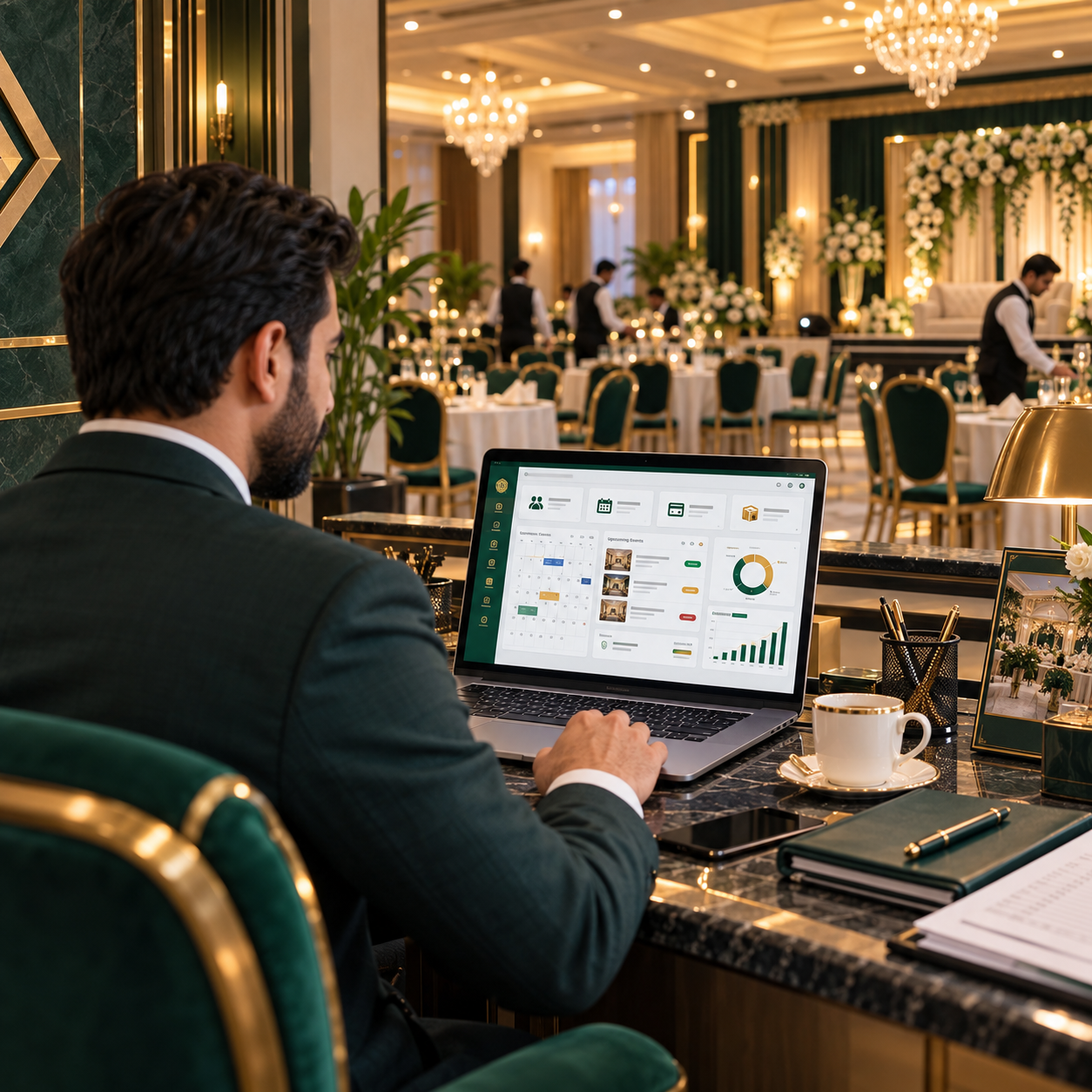
Managing a marriage hall successfully requires much more than keeping a list of booked dates.
A single event may involve a customer enquiry, quotation, hall reservation, guest count, menu, contract, advance payment, security deposit, suppliers, inventory, staff, expenses and final accounting.
When these activities are managed through separate diaries, Excel sheets, WhatsApp messages and accounting records, information can easily become disconnected.
That is why choosing the right marriage hall management software matters.
The right system should not simply replace a paper booking register with a digital calendar. It should connect the complete journey of an event from the first customer enquiry to the final financial result.
In this guide, we will look at the most important features every marriage hall owner should consider when evaluating management software.
What Should Marriage Hall Management Software Actually Do?
Marriage hall management software should provide one organized system for the operational and financial activities of a venue.
Ideally, it should connect areas such as:
- Customer enquiries
- Quotations
- Hall availability
- Tentative bookings
- Confirmed bookings
- Guest counts
- Menus and packages
- Customer contracts
- Invoices
- Customer advances
- Security deposits
- Outstanding balances
- Suppliers
- Purchases
- Inventory
- Staff
- Payroll
- Accounting
- Financial reports
- Event profitability
- Multiple halls or branches
The most important word here is connect.
A venue can already manage all these activities manually using different tools.
The real value of a dedicated system comes when information does not need to be repeatedly entered into separate places.
For example:
Customer Enquiry → Quotation → Booking → Payment → Event Operations → Accounting → Profitability
That connected workflow gives management much better control over the business.
1. Customer and Enquiry Management
Every event starts with a potential customer.
Before a booking is confirmed, your staff may receive several enquiries for the same date.
A good marriage hall management system should help the front desk maintain customer information in an organized way.
Important information can include:
- Customer name
- Mobile number
- Event type
- Preferred date
- Preferred hall
- Expected guest count
- Previous quotations
- Previous bookings
- Customer payment history
Without centralized customer records, staff may have to search through notebooks, WhatsApp conversations or previous Excel files to understand what was discussed.
This becomes even more difficult when one employee starts the conversation and another employee follows up later.
A centralized customer profile creates continuity.
2. Professional Quotation Management
Marriage hall customers often ask for a quotation before making a final decision.
That quotation may include:
- Hall charges
- Guest quantity
- Per-head rate
- Menu items
- Decoration
- Additional services
- Special discounts
- Taxes
- Other charges
Creating every quotation manually increases the chance of inconsistent pricing or missing information.
A proper management system should allow the venue to prepare structured quotations using predefined packages, menus or pricing rules.
The quotation should remain attached to the customer record.
Even more importantly, once the customer accepts the quotation, your staff should not have to enter all the same information again.
The preferred workflow is:
Prepare Quotation → Customer Accepts → Convert to Booking
This saves time and reduces data-entry mistakes.
3. Real-Time Hall Availability
One of the most important features of any marriage hall booking software is venue availability.
A paper diary usually answers only one question:
Is something written against this date?
But a proper venue system may need to consider much more.
For example:
- Which hall is being booked?
- What time does the event start?
- What time does it end?
- Is another event already scheduled?
- Does the venue have multiple halls?
- Is it an overnight function?
- Has another booking been postponed to this date?
- Is the booking tentative or confirmed?
A professional booking system should help staff identify conflicts before making a commitment to the customer.
You can learn more about Venue Khata's dedicated marriage hall booking software.
4. Booking Conflict Prevention
Double booking can create one of the most serious operational problems for a marriage hall.
Imagine two families arriving for events that have accidentally been confirmed for the same hall and time.
The financial damage can be significant, but the damage to customer trust may be even greater.
Marriage hall software should therefore do more than display a calendar.
It should help detect overlapping event times when staff create or change bookings.
Conflict prevention becomes particularly important for businesses operating:
- Multiple halls
- Multiple event slots
- Morning and evening functions
- Overnight events
- Multiple branches
The system should help staff identify the conflict before the booking is finalized.
5. Tentative and Confirmed Booking Status
Not every customer who asks for a date immediately confirms it.
Some customers may request time to make a decision.
Others may receive a quotation but never return.
A useful system should clearly distinguish different stages of a booking.
These may include:
- Enquiry
- Quotation
- Waitlist
- Tentative booking
- Confirmed booking
- Postponed
- Rescheduled
- Cancelled
- Completed
This distinction prevents the team from treating every enquiry as a final commitment.
It also allows management to understand the actual booking pipeline.
6. Guest Count Management
Guest quantity is one of the most important numbers associated with a marriage hall event.
It can influence:
- Food preparation
- Seating
- Table arrangements
- Staff requirements
- Ingredient purchases
- Final billing
- Event profitability
The difficulty is that guest counts frequently change.
A customer may initially book for 400 guests and later increase the count to 500.
The final number should remain connected to the same booking rather than being updated manually in multiple registers.
A venue management system should make it easy to update the guest count while maintaining accurate event information.
7. Menu and Package Management
For venues that provide food or catering, menu management should be part of the booking workflow.
Instead of manually typing dishes for every event, software should allow venues to maintain reusable information such as:
- Packages
- Menu categories
- Individual dishes
- Per-head rates
- Quantity-based charges
- Additional services
This makes quotations faster and more consistent.
It also creates a better connection between what was sold to the customer and what the operations or kitchen team needs to prepare.
8. Customer Contract Management
Once a booking is confirmed, the agreement between the customer and venue should be clearly documented.
Important details may include:
- Event date
- Venue
- Event timing
- Guest count
- Package
- Menu
- Total amount
- Advance
- Outstanding balance
- Security deposit
- Terms and conditions
If contracts are prepared completely separately from the booking system, changes can create inconsistencies.
For example, the guest count might be updated in the booking register but remain unchanged in the customer's contract.
Keeping booking information and documents connected reduces this risk.
9. Customer Invoices
Professional invoicing is another essential feature.
An invoice should reflect what the customer has actually purchased.
Depending on the venue, this could include:
- Hall charges
- Catering
- Per-head charges
- Decoration
- Additional services
- Extra items
- Taxes
- Adjustments
The invoice should remain connected with the customer's booking and financial history.
If a correction is required later, the system should maintain a proper record instead of simply replacing historical information without explanation.
10. Customer Advance Management
Marriage hall bookings commonly involve multiple payments.
A customer might make:
- An advance when confirming the booking
- Another payment before the event
- A final payment near the event date
- A separate refundable security deposit
Your software should make it easy to answer:
How much has this customer paid?
and:
How much is still outstanding?
Without this visibility, staff may have to compare booking registers, bank transactions, cash notebooks and accounting records.
A connected system makes customer balances much easier to understand.
11. Security Deposit Tracking
Security deposits deserve special treatment.
A refundable deposit should not automatically be treated the same way as normal event revenue.
The business may need to refund the amount after the event if all conditions are satisfied.
A good marriage hall system should therefore help the accounts team keep security deposits identifiable separately from normal booking collections.
The team should be able to follow the deposit through:
Receipt → Holding → Refund or Adjustment
This creates much stronger financial control.
12. Outstanding Balance Management
A busy marriage hall may have dozens of future events.
Each customer may have paid a different percentage of the total amount.
Management needs a clear view of:
- Total booking value
- Amount collected
- Amount outstanding
- Payment history
- Due amounts
This information is especially valuable when an event date is approaching.
Your team should not discover on the morning of the function that a large balance remains unpaid.
Outstanding-balance reporting helps management follow up before the problem becomes urgent.
13. Proper Double-Entry Accounting
One of the biggest differences between simple booking software and a complete venue ERP is accounting.
A booking calendar tells you what functions are scheduled.
It does not tell you the financial position of the business.
A serious marriage hall management system should provide proper accounting functionality or integrate tightly with an accounting process.
Important accounting capabilities include:
- Chart of accounts
- Customer ledgers
- Supplier ledgers
- Cash vouchers
- Bank vouchers
- Journal vouchers
- Opening balances
- Receivables
- Payables
- Advances
- Deposits
- Financial statements
Venue Khata includes connected marriage hall accounting software so operational activity and financial records do not need to live in completely separate systems.
14. Cash and Bank Management
Marriage halls receive and make payments through different methods.
A business may need to manage:
- Cash received from customers
- Bank transfers
- Supplier payments
- Refunds
- Staff payments
- Other business expenses
Management should be able to understand where money came from and where it went.
This is much more useful than simply looking at the current cash or bank balance.
A healthy balance does not necessarily mean the business is profitable.
Some of that money may represent:
- Customer advances
- Refundable deposits
- Unpaid supplier obligations
- Future event commitments
Proper accounting provides the context behind the balance.
15. Supplier Management
Marriage halls often depend on many suppliers.
Depending on the business model, these may provide:
- Food ingredients
- Beverages
- Decoration
- Furniture
- Lighting
- Flowers
- Equipment
- Cleaning supplies
- Other event services
The software should maintain organized supplier records.
Management should be able to understand:
- What was purchased
- Which supplier provided it
- Whether it was paid immediately
- What amount remains payable
- When payments were made
Supplier balances are particularly important for businesses purchasing goods on credit.
16. Purchase Management
Purchasing should not be completely disconnected from the rest of the business.
A useful system should support both:
- Cash purchases
- Credit purchases
When a purchase is recorded, it should contribute to the appropriate supplier, inventory and accounting records.
This reduces repeated data entry and creates a clearer financial trail.
17. Inventory Management
Inventory can have a major impact on marriage hall profitability.
The business may maintain:
- Food ingredients
- Beverages
- Disposable items
- Cleaning supplies
- Event consumables
- Other stock
A venue management system should help staff understand stock movements.
Important capabilities may include:
- Stock-in records
- Stock adjustments
- Current quantities
- Supplier purchases
- Inventory valuation
- Consumption records
Inventory management is especially important when the venue handles its own catering.
Small stock losses repeated across many events can significantly affect annual profit.
18. Food Cost Management
Food is often one of the largest event-related costs for marriage halls and banquet businesses.
Knowing only the selling price of the package is not enough.
Management should also understand what the food required to deliver that event actually cost.
For example, an event might generate strong revenue but have unusually high ingredient consumption.
Without food-cost visibility, management may think the event performed better than it actually did.
A connected ERP can help bring ingredient costs into event-level reporting.
19. Event Expense Tracking
Not every event cost comes from inventory.
An event may have additional expenses such as:
- External vendors
- Temporary labour
- Decoration
- Equipment
- Special arrangements
- Transport
- Other function-specific expenses
These expenses should be attached to the relevant event whenever possible.
Otherwise, management can see total monthly expenses but cannot easily understand which bookings produced those costs.
Event-level expense tracking makes profitability reporting far more meaningful.
20. Event Profitability
This is one of the most valuable features for an owner.
A fully booked calendar does not automatically mean a highly profitable business.
One event may generate Rs. 900,000 in revenue but also require very high costs.
Another event may produce lower revenue but a much better margin.
Management needs to understand the difference.
A useful event-profitability view should bring together relevant event information such as:
- Booked charges
- Recorded event expenses
- Ingredient food costs
This allows the owner to understand what remains after the recorded direct costs of delivering the event.
Venue Khata provides a dedicated event profitability report.
It is important to remember that event-level profitability and overall company profit are not always the same thing.
General overhead such as rent, office expenses or other business-wide costs may still need to be reviewed through the financial statements.
21. Employee Management
Marriage halls depend heavily on staff.
The system may need to maintain information for:
- Front-desk staff
- Accounts team
- Kitchen employees
- Event workers
- Managers
- Support staff
Central employee records make it easier to manage staffing information without relying on separate files.
22. Attendance Management
If payroll depends on attendance, the system should help maintain employee attendance records.
This can provide better visibility into:
- Presence
- Absence
- Working days
- Employee history
When attendance, employees and payroll are maintained in different places, salary preparation becomes more time-consuming.
Connecting them makes the process more controlled.
23. Salary Advances and Deductions
Employees may receive salary advances during the month.
If those advances are written only in a notebook, they can easily be missed during payroll preparation.
The software should allow the business to maintain:
- Salary advances
- Recoveries
- Adjustments
- Deductions
This creates a clear trail between employee activity and the final salary calculation.
24. Payroll Management
Payroll is another important cost of running a venue.
Useful payroll features may include:
- Salary setup
- Attendance connection
- Salary advances
- Adjustments
- Deductions
- Payslips
- Payroll finalization
- Payment accounting
When payroll connects with accounting, management gets a more complete view of business expenses.
25. Reservation and Operational Reports
The event team does not always need financial information.
Sometimes they simply need a clean operational view of what must be prepared.
Useful operational reports can help staff see:
- Event information
- Guest quantities
- Menu quantities
- Venue details
- Booking schedule
A good ERP should provide information appropriate to the team using it rather than forcing every employee to work through accounting screens.
26. Receivable Reports
Receivables show amounts customers still owe to the business.
This is particularly important for marriage halls because customers often pay in installments.
Useful receivable reporting helps management identify:
- Outstanding customers
- Large unpaid balances
- Overdue amounts
- Payments requiring follow-up
A venue can have strong sales on paper while experiencing cash-flow problems if collections are slow.
27. Payable Reports
Payables show amounts the business owes to suppliers or other parties.
Ignoring payables can create an unrealistic picture of available cash.
For example, a venue may have Rs. 2 million in the bank but also owe a significant amount to suppliers.
Management needs both pieces of information before making spending decisions.
28. Financial Statements
A serious business system should help management move beyond daily transactions.
Important financial statements include:
- Income statement
- Balance sheet
- Cash flow statement
- Trial balance
These reports answer different questions.
Income Statement
Shows the financial performance of the business over a period.
Balance Sheet
Shows assets, liabilities and equity at a particular point in time.
Cash Flow
Helps management understand how cash moved through the business.
Trial Balance
Provides the accounting team with a structured view of ledger balances.
Venue owners do not need to become accountants, but they should have access to accurate financial information.
Explore the current Venue Khata reports.
29. Multi-Hall Management
Many businesses operate more than one hall within the same property.
For example:
- Hall A
- Hall B
- Lawn
- Rooftop
- Banquet area
The system should treat each venue as a distinct bookable space while still giving management an overall view.
This is especially important for availability checks.
A business may have one hall occupied while another remains available during the same period.
30. Multi-Branch Management
As a venue business grows, it may open additional locations.
The software should be able to grow with it.
Useful multi-branch capabilities include:
- Separate branch records
- Secure branch switching
- Branch-specific operations
- Management-level oversight
- Consolidated reporting
A system that works only for one small venue can become a limitation later.
It is better to consider scalability before expansion begins.
31. Role-Based User Permissions
Not every employee should see or change everything.
Different employees need different levels of access.
For example:
Front Desk
May need:
- Customers
- Quotations
- Availability
- Bookings
Accounts Team
May need:
- Payments
- Vouchers
- Ledgers
- Financial reports
Operations Team
May need:
- Guest counts
- Menus
- Event details
- Run sheets
Owner or Management
May need:
- Complete reports
- Event profitability
- Branch information
- Financial visibility
Role-based permissions help keep sensitive business information controlled.
32. Activity History and Auditability
When important financial or operational information changes, management may need to understand what happened.
A controlled system should maintain appropriate activity history for sensitive actions.
This becomes increasingly important when:
- More employees use the software
- The business has multiple branches
- Financial transactions are processed regularly
- Management is not physically present every day
Accountability becomes more difficult when anyone can freely change historical information without a trace.
33. Data Backup and Business Continuity
Venue data can become extremely valuable over time.
It may contain:
- Customer records
- Booking history
- Financial data
- Supplier information
- Employee records
- Historical reports
Losing this information can seriously disrupt the business.
When evaluating software, ask:
- How is data backed up?
- Can business data be exported?
- How is access protected?
- What happens if hardware fails?
- How does the provider handle recovery?
These questions may appear less exciting than dashboards and booking calendars, but they are essential for long-term business continuity.
34. Pakistan-Focused Financial Workflows
Software designed for another country may technically work in Pakistan but still create unnecessary friction.
Pakistani venue businesses benefit from systems designed around local needs.
These can include:
- PKR-based financial workflows
- Pakistani rupee formatting
- Local terminology
- Provincial sales tax information
- Local subscription payment options
- Support through familiar communication channels
Venue Khata is specifically built for Pakistan and supports local subscription payment methods including bank transfer, JazzCash and Easypaisa.
35. Simple Front-Desk Experience
A management system can have hundreds of features and still fail if staff find it difficult to use.
Your front desk works in a fast environment.
A customer may be waiting while the employee needs to:
- Check availability
- Prepare a quotation
- Find a previous customer
- Update guest quantities
- Record a payment
- Check an outstanding balance
These actions should not require navigating through complicated accounting menus.
Software should be designed for the people who actually use each part of it.
36. Connected Departments
This is perhaps the most important feature of all.
Many businesses already use software.
The problem is that each department uses a different system.
For example:
Front Desk: Excel
Accounts: Accounting software
Kitchen: Printed sheets
Inventory: Another Excel file
Management: WhatsApp updates
Digital tools alone do not solve the problem if the information remains disconnected.
A proper venue ERP should allow departments to continue working from the same underlying event record.
That means the booking created by the front desk can eventually contribute to the financial and management information reviewed by the owner.
What Features Does a Small Marriage Hall Need First?
A smaller marriage hall does not necessarily need to implement every advanced feature on the first day.
The most important starting areas are usually:
- Customer records
- Quotations
- Booking availability
- Conflict prevention
- Customer advances
- Outstanding balances
- Basic accounting
- Supplier tracking
- Financial reports
Once these processes are stable, the business can expand into:
- Inventory
- Procurement
- Payroll
- Event costing
- Multi-branch management
The objective should be gradual improvement rather than trying to change every business process overnight.
What Features Become Important as the Venue Grows?
Growth creates additional complexity.
When a marriage hall becomes busier, problems that were once manageable manually become harder to control.
A growing business should pay particular attention to:
Permissions
More employees mean greater need for controlled access.
Inventory
More events mean more purchasing and stock movement.
Receivables
More customers mean more outstanding balances to follow.
Payables
More suppliers mean more liabilities to manage.
Event Profitability
Higher sales make cost control increasingly important.
Multi-Branch Reporting
Expansion requires management to understand both individual branches and the overall business.
A system should therefore support where the business wants to go, not only where it is today.
Booking Software vs Complete Venue ERP
This distinction is important when evaluating products.
Basic Booking Software
Usually focuses on:
- Calendar
- Customers
- Dates
- Venue reservations
- Booking status
This can be sufficient for businesses that already have strong systems for everything else.
Complete Venue ERP
Extends beyond the booking and can connect:
- Quotations
- Customer payments
- Accounting
- Purchases
- Suppliers
- Inventory
- Payroll
- Financial reports
- Event profitability
- Branch management
The right choice depends on the actual requirements of your business.
If your biggest problem is only calendar management, simple booking software may solve it.
But if you currently maintain multiple disconnected systems for bookings, accounts, inventory and reports, a complete ERP may provide more value.
Questions to Ask Before Choosing Marriage Hall Software
Before making a decision, ask the software provider practical questions based on your real workflow.
Booking Questions
- Can it manage multiple halls?
- Does it detect overlapping event times?
- Can quotations convert into bookings?
- Can events be rescheduled?
- Can guest counts and menus be updated?
Customer Questions
- Can staff see payment history?
- Are advances tracked properly?
- Are refundable deposits identifiable separately?
- Can outstanding balances be reported?
Accounting Questions
- Does it include double-entry accounting?
- Are customer and supplier ledgers available?
- Does it provide financial statements?
- Are reversals and financial controls available?
Inventory Questions
- Can purchases increase stock?
- Can inventory adjustments be recorded?
- Can supplier balances be tracked?
- Can food cost contribute to event reporting?
Management Questions
- Can the owner see event profitability?
- Are reports available for multiple branches?
- Can different employees have different permissions?
- Is business data backed up?
Do not evaluate software only from screenshots.
Ask the provider to demonstrate how one real event moves through the complete system.
A Practical Demo Scenario to Test Any Software
When receiving a software demonstration, use a realistic scenario.
For example:
Step 1
Create a customer planning a wedding for 500 guests.
Step 2
Prepare a quotation with a menu and hall package.
Step 3
Check whether the hall is available.
Step 4
Convert the quotation into a confirmed booking.
Step 5
Record an advance payment.
Step 6
Record a refundable security deposit.
Step 7
Increase the guest count.
Step 8
Record event-related purchases or expenses.
Step 9
Collect the customer's remaining payment.
Step 10
Review the customer's ledger and outstanding balance.
Step 11
Check the financial posting.
Step 12
Review the profitability of the completed event.
If software can handle this entire scenario clearly, you will understand its value much better than by looking at a dashboard.
How Venue Khata Connects These Features
Venue Khata is a marriage hall and event venue ERP built around a connected event workflow.
Instead of treating bookings and accounting as unrelated activities, Venue Khata connects the customer journey with operations and financial records.
The workflow can move through:
Enquiry → Quotation → Booking → Contract → Customer Payments → Event Operations → Accounting → Profitability
Its current feature set includes areas such as:
- Customer and quotation management
- Marriage hall bookings
- Multi-venue availability checks
- Time-slot conflict prevention
- Guest counts and menus
- Contracts and invoices
- Customer advances
- Security deposits
- Double-entry accounting
- Customer and supplier ledgers
- Inventory and purchasing
- Supplier balances
- Employee records
- Payroll
- Event profitability
- Financial reports
- Branch management
- Role-based permissions
- Activity controls
- Backup tooling
Explore the complete Venue Khata features.
Why Connected Software Matters More Than Having More Features
When comparing systems, it is easy to count features.
One software may advertise 50 features and another may advertise 100.
That does not automatically tell you which system will work better.
What matters is how those features connect.
Consider this example.
A customer pays an advance.
In a disconnected system, staff may need to:
- Write the amount against the booking
- Enter it into an Excel sheet
- Inform the accountant
- Enter it again in accounting software
- Recalculate the customer's outstanding balance
Every additional manual step creates another opportunity for error.
In a connected workflow, the payment should remain linked with the relevant customer and financial records.
That is the difference between simply having features and having an integrated business system.
Signs Your Marriage Hall Needs Better Management Software
Your business may have outgrown its current system if:
- Staff frequently ask each other whether a hall is available
- Booking details exist in multiple registers
- Customer advances are difficult to reconcile
- Outstanding balances require manual calculation
- Security deposits are mixed with normal receipts
- Supplier balances are unclear
- Inventory records are often outdated
- Accounts are maintained separately from bookings
- Management cannot see event-level profitability
- Different branches send reports manually
- Important information depends on one employee
- Monthly reporting takes several days to prepare
The objective of adopting software should be to reduce these problems.
Final Thoughts
The best marriage hall management software features are not the ones that make the longest product brochure.
They are the features that give your team better control over the real problems involved in running a venue.
For most marriage hall businesses, those priorities are:
- Accurate booking management
- Conflict prevention
- Customer payment tracking
- Proper accounting
- Supplier control
- Inventory visibility
- Staff management
- Financial reporting
- Event profitability
- Management oversight
Most importantly, these features should work together.
The strongest venue system is one where the information created at the front desk remains useful to operations, accounts and management throughout the complete life of the event.
If your marriage hall currently depends on separate registers, spreadsheets and disconnected applications, moving toward one connected system can provide much clearer control over both operations and finances.
Explore Venue Khata to see how bookings, operations, accounting and event profitability can work together in one system built for Pakistani marriage halls, marquees and banquet venues.
Frequently Asked Questions
What features should marriage hall management software have?
Important features include customer management, quotations, hall availability, booking conflict prevention, guest counts, menus, customer advances, security deposits, accounting, suppliers, inventory, payroll, financial reporting and event profitability.
What is the most important feature of marriage hall booking software?
Availability and booking-conflict prevention are among the most important operational features because they help staff avoid committing the same hall to overlapping events.
Does a marriage hall need accounting software?
A marriage hall operates as a financial business as well as an event venue. Proper accounting helps management track customer balances, suppliers, expenses, assets, liabilities, cash flow and overall profitability.
Why is event profitability important?
Revenue alone does not show whether an event performed well financially. Event profitability helps management compare booked charges with relevant recorded event costs.
Can marriage hall software manage inventory?
A complete venue ERP can include purchases, stock movements, supplier balances, inventory valuation and food-cost reporting.
Can marriage hall management software support multiple halls?
Yes. A suitable system should allow businesses operating several bookable venues to maintain separate availability while keeping management information connected.
Can marriage hall software support multiple branches?
Some complete venue ERP systems support multiple branches, branch switching and consolidated management reporting. This should be confirmed before selecting a product if expansion is part of your business plan.
What is the difference between booking software and venue ERP?
Booking software primarily manages customers, calendars and reservations. A venue ERP extends the workflow into areas such as accounting, purchases, inventory, payroll, suppliers, reports and event profitability.
Is Venue Khata suitable for Pakistani marriage halls?
Venue Khata is specifically designed for marriage halls, marquees and banquet venues in Pakistan and includes PKR-focused workflows along with local subscription payment options.
Where can I see all Venue Khata features?
You can review the complete feature overview at Venue Khata Features.