
Why Fully Booked Marriage Halls Can Still Lose Money
A full booking calendar does not always mean a profitable marriage hall. Learn how food cost, discounts, wastage, supplier expenses, unpaid balances and weak event costing can reduce profits even when business looks busy.
By Venue Khata ·
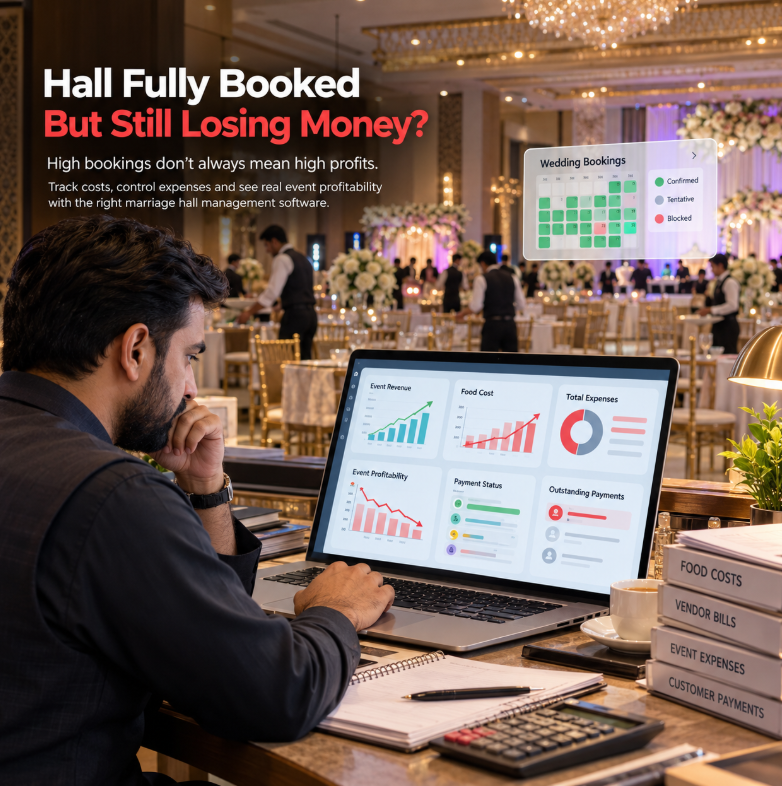
A full marriage hall calendar looks like success.
Weekends are booked.
Customers are paying advances.
The reception desk is busy.
The kitchen is working continuously.
Suppliers are delivering stock.
Staff are preparing one event after another.
From the outside, everything appears healthy.
But there is one important question:
Is the venue actually making money?
A marriage hall can be busy and still produce weak financial results.
In some cases, the business may even lose money despite having a strong booking calendar.
This happens because bookings, revenue, cash and profit are not the same thing.
A venue may have high sales but also experience:
- Rising food costs
- Excessive discounts
- Inventory wastage
- Expensive vendors
- Uncontrolled event expenses
- Large outstanding customer balances
- High payroll
- Supplier liabilities
- Weak pricing
- Unrecorded costs
If management only looks at how many events are booked, these problems can remain hidden.
This guide explains why fully booked marriage halls can still lose money and what owners can do to improve financial control.
A Full Calendar Does Not Guarantee Profit
The number of bookings tells you how busy the venue is.
It does not tell you how profitable those bookings are.
Imagine two marriage halls.
Venue A
Venue A has 25 events this month.
The owner is proud because almost every weekend and several weekdays are booked.
But many bookings were heavily discounted.
Food costs are rising.
Several customers still owe large balances.
Staff overtime is high.
Some vendors have not been paid.
Venue B
Venue B has only 18 events.
But its pricing is stronger.
Food wastage is controlled.
Customer collections are disciplined.
Vendor costs are tracked.
Packages are reviewed regularly.
Venue B may generate better profit despite handling fewer events.
This is why venue owners should measure more than booking volume.
Revenue Is Not the Same as Profit
Suppose a marriage hall books an event for:
Rs. 1,000,000
That number represents revenue associated with the event.
Now consider the costs.
The venue spends:
- Rs. 320,000 on food and ingredients
- Rs. 120,000 on decoration and vendors
- Rs. 60,000 on temporary labour
- Rs. 40,000 on other event expenses
Total direct event cost:
Rs. 540,000
What remains before general business overhead:
Rs. 460,000
The original Rs. 1,000,000 booking value looked impressive.
But profitability can only be understood after costs are considered.
This is why every hall owner should understand event profitability.
Cash Is Not the Same as Profit Either
This is another common misunderstanding.
Suppose your bank account shows:
Rs. 5,000,000
That does not automatically mean the business made Rs. 5,000,000 in profit.
The balance may include:
- Customer advances for future events
- Refundable security deposits
- Money needed to pay suppliers
- Payroll obligations
- Taxes
- Upcoming event costs
Some of that cash may already be committed.
A healthy bank balance can therefore create a false sense of financial security.
Proper marriage hall accounting helps separate cash position from actual business profitability.
1. Food Cost Is Too High
For marriage halls providing catering, food cost can be one of the largest event expenses.
A venue may have strong pricing but still lose margin because ingredient costs are poorly controlled.
Common reasons include:
- Over-purchasing
- High supplier prices
- Poor portion control
- Kitchen wastage
- Unrecorded consumption
- Expired stock
- Excessive menu items
- Emergency purchases at high prices
Even a small food-cost problem becomes significant across many events.
If the venue handles 30 events per month, a Rs. 20,000 unnecessary food-cost increase per event equals:
Rs. 600,000 per month
That is why inventory and food costing should be taken seriously.
2. Package Prices Have Not Been Updated
Many marriage halls create packages and then continue selling them at the same price for too long.
But costs change.
Over time:
- Meat prices increase
- Chicken prices increase
- Rice prices change
- Cooking oil becomes more expensive
- Labour costs rise
- Utilities increase
- Vendor rates increase
If package prices remain unchanged while costs rise, the margin becomes smaller.
The venue may continue booking more events but make less money on each one.
Management should regularly review:
- Package selling price
- Ingredient cost
- Vendor cost
- Labour cost
- Event contribution
Historical profitability can help identify packages that need repricing.
3. Discounts Are Too Aggressive
Discounts can help close a booking.
But discounts directly reduce the amount available to cover costs and profit.
Suppose a package normally sells for:
Rs. 900,000
A customer asks for:
Rs. 100,000 discount
The event is now sold for:
Rs. 800,000
If direct costs remain the same, that Rs. 100,000 reduction comes out of the event's contribution.
Now imagine sales staff repeatedly use large discounts to fill the calendar.
The venue may look extremely busy.
But margin may be falling with every booking.
Discounts should therefore have:
- Clear limits
- Approval rules
- Minimum margin expectations
- Management oversight
A full calendar built on weak pricing is not necessarily a healthy business.
4. Extra Services Are Given Away for Free
Customers often request additions after the original quotation.
For example:
- More guests
- Extra menu items
- Additional decoration
- Extra chairs
- Extended event time
- Special lighting
- Additional staff
- Premium serving items
Sometimes staff agree to these additions to keep the customer happy.
But if the extra service has a cost and the customer is not charged, the venue's margin falls.
One free addition may seem minor.
Several free additions across many events can become a major financial leak.
Every significant extra should be:
- Recorded
- Approved
- Costed
- Charged where appropriate
5. Final Guest Count Is Not Controlled
Guest count affects revenue and cost.
Suppose the customer originally books:
400 guests
The kitchen prepares for:
500 guests
but the customer is still billed for only:
400 guests
The venue has absorbed the cost of 100 extra servings.
This can happen when:
- Guest-count changes are not recorded
- Sales staff promise flexibility
- Operations receives different numbers from accounts
- Final guest quantity is not confirmed
- Extra guests are not billed correctly
The final guest count should be part of the booking workflow.
This is one of the reasons dedicated marriage hall booking software becomes valuable.
6. Food Wastage Is Not Monitored
Food wastage can quietly destroy profit.
Wastage may happen through:
- Overproduction
- Incorrect guest estimates
- Large portion sizes
- Poor stock rotation
- Spoilage
- Damaged inventory
- Excess preparation
- Uncontrolled kitchen usage
The venue may still have satisfied customers and a full calendar.
But every kilogram of unused or wasted inventory increases cost.
Management should review:
- What was purchased
- What was issued
- What was consumed
- What remained
- What was wasted
Without inventory discipline, food cost becomes difficult to control.
7. Supplier Prices Are Not Compared
A busy venue purchases large quantities.
That creates both risk and opportunity.
If the business buys from suppliers without regularly reviewing rates, it may pay more than necessary.
A small price difference on one item may not matter much.
But across:
- Meat
- Chicken
- Rice
- Oil
- Beverages
- Cleaning supplies
- Decorations
- Rentals
the total difference can become significant.
Venue owners should periodically compare:
- Supplier price
- Quality
- Reliability
- Credit terms
- Delivery performance
The cheapest supplier is not always the best.
But the business should know what it is paying.
8. Emergency Purchases Increase Cost
Poor planning often leads to last-minute purchases.
For example:
The kitchen discovers on the morning of the event that an important ingredient is missing.
Staff buy it urgently from the nearest supplier.
The price may be much higher.
Emergency purchasing also creates:
- Less negotiation power
- Poor quality control
- Duplicate purchases
- Weak inventory records
A proper procurement and inventory process can reduce these costs.
9. Supplier Payables Are Ignored
A venue may have strong cash today but still owe large amounts to suppliers.
For example:
Cash and bank: Rs. 4,000,000
Supplier payables: Rs. 2,500,000
The true financial situation is very different from simply saying:
We have Rs. 4 million available.
Management should regularly monitor what the business owes.
Supplier liabilities are part of the financial picture.
Ignoring them can lead to sudden cash pressure later.
10. Customer Outstanding Balances Are Too High
A venue may report large booking values but still have poor cash flow.
Suppose this month's events total:
Rs. 12,000,000
But customers have only paid:
Rs. 8,000,000
The business still needs to collect:
Rs. 4,000,000
Meanwhile, suppliers and staff still need to be paid.
This creates cash-flow pressure.
Management should track:
- Total customer balance
- Amount collected
- Amount outstanding
- Event date
- Follow-up status
A fully booked business with weak collections can still struggle to pay its bills.
11. Final Payments Are Collected Too Late
Some venues wait until after the event to collect a large portion of the balance.
That creates unnecessary risk.
After the function is completed, the venue has less leverage.
A better payment policy may require a significant percentage before the event.
The exact structure depends on the business.
But it should be:
- Clear
- Written
- Consistent
- Tracked
Customer outstanding balances should never be a surprise on the event day.
12. Refundable Deposits Are Treated as Income
Suppose customers have collectively paid:
Rs. 1,000,000 in security deposits
That money may currently be in the venue's bank account.
But if those deposits are refundable, the business may need to return them.
Treating the full amount as revenue creates an inaccurate view of business performance.
Refundable security deposits should remain separately identifiable.
13. Event Expenses Are Not Assigned Correctly
Suppose one event requires:
- Special lighting
- External decoration
- Additional chairs
- Temporary staff
- Equipment rental
If these expenses are simply recorded as general monthly expenses, management cannot see how much that particular event actually cost.
The event may appear highly profitable when it was not.
Direct event expenses should remain connected to the relevant booking where practical.
14. Small Expenses Are Ignored
Large expenses get attention.
Small expenses are often ignored.
Examples include:
- Transport
- Ice
- Cleaning material
- Small rentals
- Staff meals
- Emergency purchases
- Tips
- Extra fuel
- Miscellaneous event supplies
One Rs. 5,000 expense seems insignificant.
But if each event has several unrecorded small expenses, the total becomes substantial.
Accurate profitability requires complete data.
15. Staff Overtime Is Too High
Busy venues often rely on overtime.
During peak wedding season, this may be necessary.
But uncontrolled overtime increases labour cost.
Management should understand:
- Which events require extra hours
- Why overtime occurred
- Whether staffing can be scheduled better
- Whether temporary workers would be more economical
- Whether event pricing reflects increased labour requirements
A full booking calendar can become expensive if every event requires excessive additional labour.
16. Payroll Is Growing Faster Than Revenue
Hiring more staff can improve service.
But payroll should be monitored as the business grows.
If monthly payroll increases significantly while revenue or contribution remains flat, the venue may become less profitable.
Management should regularly review:
- Number of employees
- Salary expense
- Overtime
- Advances
- Temporary staff
- Revenue per period
- Contribution per period
The goal is not to minimize staff at all costs.
The goal is to maintain the service level efficiently.
17. Utilities Are Not Controlled
Marriage halls can have significant utility costs.
These may include:
- Electricity
- Gas
- Water
- Generator fuel
A busy calendar increases usage.
But poor operational control can push these costs much higher than necessary.
Examples include:
- Air conditioning running too early
- Lighting left on unnecessarily
- Inefficient equipment
- Fuel leakage
- Poor maintenance
General overhead does not appear directly on an individual booking invoice, but it affects overall company profit.
18. Repairs and Maintenance Are Ignored in Pricing
A marriage hall must continuously maintain:
- Furniture
- Air conditioning
- Kitchen equipment
- Lighting
- Sound
- Building
- Washrooms
- Generators
- Vehicles
These costs may not occur every day.
But they are part of running the business.
If pricing decisions consider only food and immediate event expenses, long-term costs can be underestimated.
19. Marketing Costs Are Forgotten
A venue may spend heavily on:
- Social media advertising
- Photography
- Video production
- Influencers
- Event portals
- Sales commissions
- Outdoor advertising
These costs may successfully produce bookings.
But they still reduce overall company profit.
Management should understand how much it spends to generate business.
20. Booking Revenue Is Recorded but Costs Are Entered Late
This can create a dangerous reporting illusion.
Imagine an event is completed today.
Revenue is recorded immediately:
Rs. 900,000
The profitability report looks excellent.
But supplier invoices arrive later.
Then:
- Rs. 80,000 decoration cost
- Rs. 40,000 equipment cost
- Rs. 25,000 temporary labour
are entered several days later.
The original report was incomplete.
Timely expense recording is important if management wants reliable event profitability.
21. Management Looks Only at Monthly Sales
Monthly sales are important.
But they should not be the only performance metric.
Suppose:
January sales: Rs. 15 million
February sales: Rs. 18 million
Management celebrates growth.
But February may also have:
- Higher food costs
- Larger discounts
- More staff overtime
- Higher vendor costs
- More unpaid customer balances
Sales increased.
Profit may not have increased.
Management should review both revenue and costs.
22. The Venue Does Not Know Profit Per Event
This is one of the biggest weaknesses in many event businesses.
Management knows:
- Booking amount
- Advance
- Final payment
But cannot answer:
What did this event actually cost us?
Without event-level costing, pricing decisions are mostly based on experience and intuition.
Experience is valuable.
But actual data makes decisions much stronger.
Venue Khata's event profitability reporting is designed to help management connect booked charges with relevant recorded event costs.
23. The Venue Does Not Know Which Packages Perform Best
Many venues sell packages.
For example:
- Basic
- Standard
- Premium
- Custom
One package may sell frequently but produce a weak margin.
Another may sell less often but provide stronger contribution.
Without comparing historical results, management cannot easily identify which packages deserve more promotion.
Package profitability can guide:
- Pricing
- Menu design
- Sales strategy
- Supplier negotiation
24. The Venue Is Chasing Volume Instead of Margin
There is often pressure to keep every date booked.
An empty date feels like lost revenue.
This can cause businesses to accept:
- Very low prices
- Excessive discounts
- Poor payment terms
- Unprofitable packages
Sometimes accepting a weak booking is still better than leaving a date empty.
But management should know the minimum acceptable margin.
The decision should be deliberate rather than automatic.
25. Sales Staff Are Rewarded Only for Booking Value
Imagine a sales employee is rewarded purely for:
Total bookings closed
They have a strong incentive to:
- Offer discounts
- Include free services
- Accept weak terms
- Maximize booking value
But they may not consider profitability.
A better sales-control system may require:
- Discount approval
- Minimum pricing rules
- Package limits
- Management review for exceptional deals
The goal is to align sales performance with healthy business performance.
26. The Venue Is Not Charging for Add-Ons
Add-ons can become a major source of lost margin.
Customers may request:
- Extra hours
- Additional guests
- More tables
- Additional food
- Special setup
- Extra decoration
- Additional equipment
Staff may provide these without updating the final invoice.
A proper change process should capture additional charges before the event is closed financially.
27. Multiple Departments Use Different Numbers
Reception says:
Booking value: Rs. 900,000
Accounts says:
Rs. 850,000
Operations says:
Guest count: 600
Kitchen says:
Guest count: 700
This is a serious problem.
Different numbers lead to:
- Incorrect purchasing
- Incorrect food preparation
- Incorrect billing
- Incorrect profitability
One connected event record reduces these inconsistencies.
28. Excel Files Are Not Synchronized
Excel is useful.
But if every department keeps a separate file, management may struggle.
For example:
Bookings.xlsx
CustomerPayments.xlsx
Inventory.xlsx
Suppliers.xlsx
Expenses.xlsx
Payroll.xlsx
Each file may be accurate individually.
But calculating actual event profit requires combining information manually.
This is one reason growing venues move toward dedicated management systems.
Read Marriage Hall Booking Software vs Excel for a deeper comparison.
29. Inventory Is Not Connected With Events
If inventory is tracked only monthly, management may know total consumption but not which events caused it.
For example:
Monthly chicken consumption: Rs. 1,500,000
That number is useful.
But management may also want to understand which events had unusually high ingredient costs.
Event-level inventory visibility can support better:
- Menu costing
- Pricing
- Wastage control
- Kitchen accountability
30. Theft or Leakage Goes Unnoticed
Inventory and cash leakage can occur in any large operation.
Weak controls make it harder to detect.
Warning signs may include:
- Unexpected stock shortages
- Repeated cash differences
- Supplier invoices that do not match deliveries
- Excessive consumption
- Missing receipts
Strong accounting and inventory controls improve accountability.
No software can prevent every problem automatically.
But structured records make unusual activity easier to identify.
31. Reports Are Produced Too Late
A report that arrives two months late cannot help management fix today's problem.
Suppose food cost was too high throughout September.
If management only discovers this in December, several more events may have been sold using weak pricing.
Regular reporting allows faster decisions.
Useful review periods include:
Daily
Cash and collections
Weekly
Outstanding customers and suppliers
Monthly
Financial statements and event profitability
Quarterly
Package pricing and strategic cost review
32. Owners Rely Too Much on Memory
Experienced marriage hall owners know their businesses extremely well.
But as operations grow, memory becomes less reliable.
It becomes difficult to remember:
- Which customer owes money
- Which supplier is outstanding
- Which package is profitable
- Which event had unusual costs
- Which branch performed best
Management software should support experience with data.
The goal is not to replace owner judgment.
It is to provide better information for that judgment.
33. Branch Performance Is Not Measured Separately
For businesses with multiple branches, consolidated sales can hide weak locations.
Suppose:
Branch A performs very well.
Branch B performs poorly.
Combined revenue may still look healthy.
Management should review:
- Revenue by branch
- Costs by branch
- Customer balances
- Supplier activity
- Event profitability
- Overall financial performance
Multi-branch visibility helps identify where improvement is needed.
34. Event Profit and Company Profit Are Confused
An event can be profitable while the company loses money overall.
This happens because event contribution does not automatically include all general overhead.
For example:
The venue's events may produce strong contribution.
But the business may still have very high:
- Rent
- Permanent salaries
- Marketing
- Repairs
- Utilities
- Administration
Therefore management needs two views.
Event View
How did individual functions perform?
Company View
How did the entire business perform?
Both matter.
35. Financial Statements Are Not Reviewed
Some owners manage purely from:
- Booking calendar
- Cash balance
- Bank balance
These are useful.
But they do not tell the full story.
Management should also review financial statements such as:
- Income statement
- Balance sheet
- Cash flow
These reports help answer broader questions about business performance.
Explore Venue Khata reports.
How to Know Whether Your Marriage Hall Is Actually Profitable
A useful management process should answer several levels of questions.
Booking Level
- What did we charge?
- How many guests?
- What package was sold?
Event Cost Level
- What did food cost?
- What vendors were used?
- What additional expenses occurred?
Customer Level
- How much has the customer paid?
- What remains outstanding?
Supplier Level
- What do we still owe?
Company Level
- What is total revenue?
- What are total expenses?
- What is overall profit?
- What are assets and liabilities?
- What is the cash-flow position?
The business becomes much easier to manage when these answers come from connected records.
A Simple Profitability Check After Every Event
After each major function, management can perform a short review.
Step 1: Confirm Final Booking Value
Make sure all additional services and guest changes have been included.
Step 2: Confirm Customer Collections
Identify any remaining balance.
Step 3: Review Food Cost
Check ingredient consumption.
Step 4: Review Direct Event Expenses
Include relevant vendors and special expenses.
Step 5: Calculate Event Contribution
Compare event revenue against direct event costs.
Step 6: Investigate Anything Unusual
If the margin is lower than expected, determine why.
Step 7: Apply the Learning
Use the result to improve future pricing and operations.
Questions to Ask When a Busy Month Produces Weak Profit
If your calendar was full but profit was disappointing, ask:
- Were discounts too high?
- Did food costs increase?
- Was there excessive kitchen wastage?
- Were guest counts billed correctly?
- Did customers receive free extras?
- Were vendor costs higher than expected?
- Did overtime increase?
- Are supplier prices rising?
- Were customer balances collected?
- Were all event expenses recorded?
- Did general overhead increase?
- Are packages still priced correctly?
The answer is often a combination of several issues.
How Better Booking Management Protects Profit
Profitability begins before the event happens.
A stronger booking process helps ensure:
- Correct package pricing
- Accurate guest counts
- Proper additional charges
- Clear discounts
- Customer advances
- Outstanding balances
- Confirmed event details
This prevents revenue leakage later.
Learn more about marriage hall booking software.
How Better Accounting Protects Profit
Accounting helps management understand what is happening financially.
Important areas include:
- Customer receivables
- Supplier payables
- Cash
- Bank
- Expenses
- Payroll
- Financial statements
Without accounting, management may know the business is busy but not know whether it is financially healthy.
Read our Complete Guide to Marriage Hall Accounting in Pakistan.
How Event Profitability Protects Margin
Event profitability provides another layer of visibility.
It helps answer:
Which events are actually contributing the most?
This can help identify:
- Strong packages
- Weak packages
- Costly menus
- Expensive vendors
- Excessive discounts
- Poorly priced services
Historical event profitability can then improve future quotations.
How Venue Khata Helps Connect the Numbers
Venue Khata is designed to connect the operational and financial workflows of marriage halls, marquees and banquet venues.
Instead of looking only at the booking value, management can work with connected information across areas such as:
- Quotations
- Bookings
- Customer advances
- Outstanding balances
- Accounting
- Supplier activity
- Inventory
- Event expenses
- Financial reports
- Event profitability
The objective is to provide a clearer picture of what is happening from the first customer enquiry through the financial result of the event.
Explore the complete Venue Khata features.
Five Numbers Every Marriage Hall Owner Should Know
You do not need to study every report every morning.
But management should regularly know these five numbers.
1. Upcoming Booking Value
How much future business is confirmed?
2. Customer Outstanding Balance
How much money do customers still owe?
3. Supplier Payables
How much does the business still owe suppliers?
4. Event Contribution
What remains from events after relevant direct costs?
5. Overall Company Profit
What is the final financial result after broader business expenses?
These five numbers tell a much stronger story than booking count alone.
Related Guides
Continue improving your venue's financial control with these Venue Khata guides:
- Best Marriage Hall Management Software in Pakistan
- Marriage Hall Management Software Features Every Hall Owner Needs
- How to Manage Marriage Hall Bookings Without Double Booking
- Marriage Hall Booking Software vs Excel
- Complete Guide to Marriage Hall Accounting in Pakistan
- How Marriage Hall Accounting Software Simplifies Daily Accounts
- How to Calculate the Real Profit of Every Marriage Hall Event
Final Thoughts
A full booking calendar is good.
But it is only one part of a healthy marriage hall business.
A financially strong venue needs control over:
- Pricing
- Food cost
- Customer collections
- Discounts
- Inventory
- Suppliers
- Staff costs
- Event expenses
- Receivables
- Payables
- Event profitability
- Overall company profit
If management looks only at bookings, important financial problems can remain hidden.
The goal should not simply be:
Book every available date.
The better goal is:
Book the right events at the right price, control the cost of delivering them and understand the financial result.
That is the difference between a busy marriage hall and a financially healthy marriage hall.
Explore Venue Khata to see how bookings, accounting, inventory, customer balances and event profitability can work together in one connected system built for Pakistani marriage halls, marquees and banquet venues.
Frequently Asked Questions
Can a fully booked marriage hall still lose money?
Yes. A full calendar does not guarantee profit. High food costs, discounts, wastage, vendor expenses, payroll, unpaid customer balances and general overhead can reduce or eliminate profit.
Why are marriage hall sales different from profit?
Sales represent revenue generated from events. Profit considers the costs required to provide those events and the broader expenses of running the business.
Can a marriage hall have high cash but low profit?
Yes. Cash may include customer advances, refundable deposits and money needed to pay suppliers or future event expenses.
What is the biggest cost for a marriage hall?
This varies by business, but food, payroll, vendors, utilities and other event-related expenses can all represent major costs.
How can marriage halls reduce food cost?
Venues can improve food-cost control through better purchasing, inventory management, portion control, reduced wastage and regular package-cost reviews.
Why are discounts dangerous for profitability?
Discounts reduce event revenue while many event costs remain unchanged. Excessive discounting can significantly reduce event contribution.
Why should marriage halls track customer outstanding balances?
Strong sales do not help cash flow if customers have not paid. Tracking receivables helps management collect amounts due before they become difficult to recover.
Why should supplier payables be monitored?
Supplier balances represent obligations the business still needs to pay. Ignoring them can make available cash appear stronger than it really is.
What is event profitability?
Event profitability compares event revenue with relevant direct event costs to help management understand the financial result of an individual function.
Is event profitability the same as company profit?
No. Company profit also considers broader business expenses such as permanent salaries, utilities, marketing, rent and administration.
Can Venue Khata help track event profitability?
Yes. Venue Khata includes event profitability reporting designed to connect booked event charges with relevant recorded event expenses and ingredient food costs.
How can Venue Khata help a busy marriage hall?
Venue Khata connects booking, accounting, customer balances, supplier activity, inventory, reports and event profitability so management can look beyond booking volume and understand the financial side of the business.