
How Marriage Hall Accounting Software Simplifies Daily Accounts
Learn how marriage hall accounting software can simplify daily customer receipts, supplier payments, vouchers, balances, expenses, deposits, ledgers and financial reporting for Pakistani venue businesses.
By Venue Khata ·
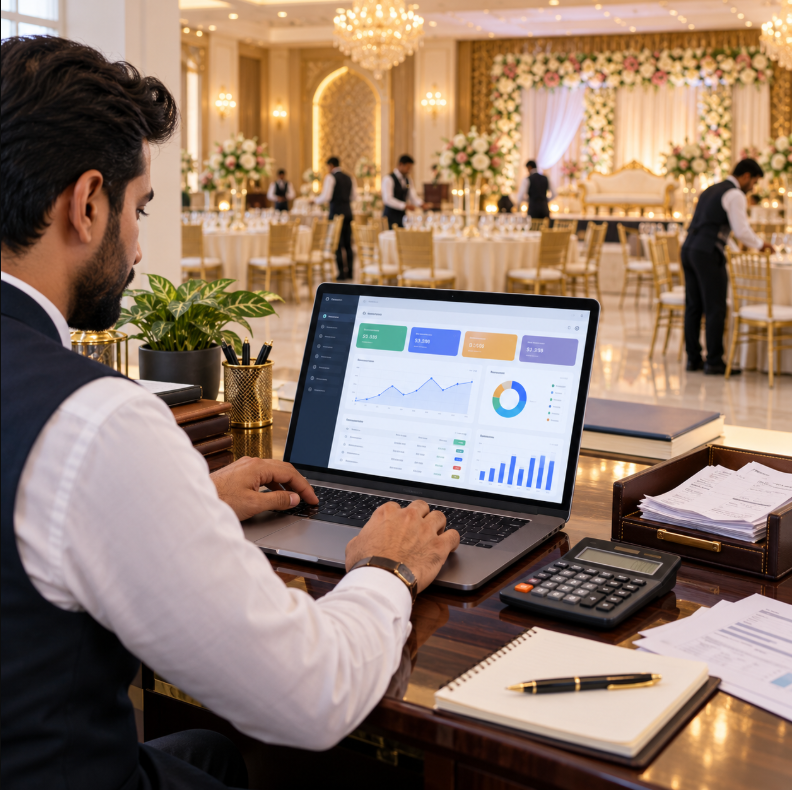
Running the daily accounts of a marriage hall can become complicated very quickly.
A normal business day may include:
- Customer advances
- Final customer payments
- Refundable security deposits
- Supplier purchases
- Supplier payments
- Cash expenses
- Bank transfers
- Salary advances
- Event expenses
- Inventory purchases
- Customer balance updates
If these transactions are recorded in separate registers, Excel sheets, WhatsApp messages and accounting files, staff spend a large amount of time simply trying to keep records synchronized.
That is where marriage hall accounting software can make a major difference.
The purpose of accounting software is not only to create financial reports at the end of the month.
A good system should simplify the daily work of the accounts team.
It should help staff record transactions once, maintain customer and supplier balances, organize vouchers and give management a clearer picture of the business.
This guide explains how marriage hall accounting software can simplify daily accounting operations for marriage halls, marquees and banquet venues.
Why Daily Accounting Becomes Difficult in Marriage Halls
Marriage halls have a different financial workflow from many ordinary businesses.
A customer may book an event months in advance.
During that period, the venue may receive several payments from the same customer.
At the same time, the business may purchase inventory, pay suppliers, issue refunds, manage staff advances and record event-related expenses.
This means accounting is connected with events that may be:
- Upcoming
- Tentative
- Confirmed
- Completed
- Rescheduled
- Cancelled
Without an organized system, the accounts team may struggle to understand which transaction belongs to which customer or event.
The Problem With Separate Registers
Many businesses begin with separate records.
For example:
Booking register
contains:
- Customer
- Date
- Hall
- Booking value
Cash register
contains:
- Money received
- Money paid
Supplier register
contains:
- Purchases
- Outstanding supplier amounts
Excel sheet
contains:
- Customer balances
Accounting software
contains:
- Financial entries
Each record may be correct individually.
The problem is that they all need to remain synchronized.
If one record is updated and another is not, management starts seeing different numbers in different places.
A connected accounting system reduces this duplication.
What Does Marriage Hall Accounting Software Do?
Marriage hall accounting software helps organize the financial activities of a venue.
Depending on the system, it can support areas such as:
- Customer collections
- Customer ledgers
- Supplier ledgers
- Cash receipts
- Cash payments
- Bank receipts
- Bank payments
- Journal entries
- Customer advances
- Security deposits
- Receivables
- Payables
- Expenses
- Payroll-related transactions
- Financial reports
- Event profitability
A venue-specific accounting system can also connect these financial activities with bookings and event operations.
That connection is particularly useful for marriage halls.
How Accounting Software Simplifies Daily Work
The biggest benefit is not that the system contains more features.
The biggest benefit is that the accounts team can follow a consistent process.
Instead of asking:
Which register should I update?
the staff member follows a defined workflow.
A customer pays an advance.
The payment is recorded.
The customer balance is updated.
The relevant cash or bank account is affected.
The transaction remains available for later reporting.
This reduces repeated manual calculations.
1. Customer Receipts Become Easier to Record
Marriage hall customers often make several payments.
For example:
Total event amount: Rs. 900,000
The customer may pay:
- Rs. 200,000 when confirming
- Rs. 300,000 before the event
- Rs. 400,000 later
Without a centralized system, each payment may need to be entered in several places.
With accounting software, staff can record each collection against the relevant customer.
This creates a proper history.
The accounts team can then see:
- Total booking amount
- Payments received
- Remaining balance
- Payment dates
- Payment method
This is much easier than manually adding payment entries every time a customer calls.
2. Customer Balances Update More Consistently
One of the most common accounting problems is disagreement over the customer's outstanding amount.
Reception may say:
Rs. 250,000 remaining
while accounts says:
Rs. 300,000 remaining
This often happens because different departments maintain separate records.
When customer collections and booking records are connected, balance tracking becomes more reliable.
Staff can review the customer's financial history instead of recalculating from several documents.
Learn more about marriage hall accounting software.
3. Cash Receipt Vouchers Create Better Records
Cash payments are common in many venue businesses.
When a customer pays cash, the business should have a clear accounting record showing:
- Who paid
- How much was paid
- Why it was received
- Which account received it
- When it was received
A Cash Receipt Voucher creates a structured record for this transaction.
This provides much better control than simply writing:
Received Rs. 100,000
in a notebook.
The voucher gives the transaction context.
4. Cash Payment Vouchers Simplify Daily Expenses
Venues regularly make cash payments.
These may include:
- Supplier payments
- Small purchases
- Staff reimbursements
- Event expenses
- General operating costs
A Cash Payment Voucher helps staff record:
- Payment amount
- Recipient
- Expense purpose
- Account
- Date
- Reference
This makes daily expense records more organized.
It also helps reduce situations where cash has left the business but nobody can later explain exactly why.
5. Bank Receipts Are Easier to Reconcile
More customers now use bank transfers.
A customer may send a payment directly to the venue's bank account.
The accounts team then needs to connect that bank transaction to the correct customer.
A structured bank receipt workflow helps record:
- Customer
- Amount
- Bank account
- Date
- Payment reference
- Related booking
This makes later bank reconciliation easier.
Instead of searching through messages asking:
Who sent this Rs. 150,000?
the payment already has a business reference.
6. Bank Payments Stay Organized
Marriage halls also make many payments through bank accounts.
Examples include:
- Supplier transfers
- Rent
- Utilities
- Salaries
- Equipment payments
- Other expenses
A Bank Payment Voucher helps the business maintain a proper trail.
This improves financial control because management can see not just that money left the bank, but also the reason for the payment.
7. Customer Advances Remain Connected to Events
Customer advances are common in marriage hall businesses.
The venue receives money before providing the service.
That payment should remain connected with the relevant event.
A good system allows staff to follow:
Booking → Advance → Additional Payment → Final Balance
This makes daily work much simpler.
The employee does not need to search the booking diary and then compare it with a separate accounts sheet.
8. Security Deposits Remain Separate
Refundable security deposits should not become confused with normal event income.
Suppose a customer pays:
Booking advance: Rs. 200,000
and
Security deposit: Rs. 50,000
These payments have different purposes.
The Rs. 200,000 contributes toward the booking balance.
The Rs. 50,000 may need to be refunded.
Accounting software can help the business keep these amounts identifiable separately.
This prevents management from mistakenly treating refundable funds as available income.
9. Supplier Purchases Become Easier to Track
Marriage halls often purchase goods from several suppliers every day.
These purchases may include:
- Food ingredients
- Beverages
- Cleaning supplies
- Event materials
- Disposable items
- Other inventory
If every supplier has a separate handwritten record, the accounts team must constantly reconcile purchases and payments.
A centralized system can maintain:
- Supplier
- Purchase amount
- Purchase date
- Cash or credit status
- Payment history
- Outstanding amount
This makes supplier management much easier.
10. Credit Purchases Become More Visible
Not every purchase is paid immediately.
A supplier may provide goods today and expect payment later.
For example:
Purchase: Rs. 300,000
Payment today: Rs. 100,000
Remaining payable: Rs. 200,000
The accounts team should not have to calculate this manually every time.
The supplier balance should update as purchases and payments are recorded.
This gives management a clearer view of what the business owes.
11. Supplier Payments Become Easier to Verify
Suppose a supplier calls and says:
You still owe us Rs. 150,000.
The accounts team should be able to review:
- Purchases
- Previous payments
- Adjustments
- Current balance
without searching through bank statements and handwritten registers.
A proper supplier ledger makes this process much faster.
12. Customer Ledgers Reduce Payment Disputes
Customer payment disputes are easier to resolve when the business has a complete ledger.
The ledger can help show:
- Charges
- Payments
- Adjustments
- Remaining balance
This gives the accounts team a clear reference when customers ask questions about previous payments.
It also reduces dependence on individual employees remembering what happened.
13. Supplier Ledgers Improve Vendor Relationships
Suppliers value businesses that maintain accurate records.
If the venue regularly disputes balances because records are unclear, supplier relationships can become difficult.
A supplier ledger helps both sides understand:
- What was purchased
- What was paid
- What remains outstanding
Accurate supplier accounting can support stronger long-term business relationships.
14. Daily Cash Position Becomes Clearer
An owner may ask:
How much cash do we have today?
The accounts team should be able to answer accurately.
But the answer becomes unreliable when receipts and payments are recorded late.
A structured daily accounting system encourages staff to record transactions when they happen.
This makes cash balances more meaningful.
15. Cash Is Not Confused With Profit
This is another important benefit of proper accounting.
A venue might have Rs. 4 million available in cash and bank.
But that amount may include:
- Customer advances
- Refundable deposits
- Money needed for future events
- Amounts owed to suppliers
Therefore, the business cannot assume:
Cash available = Profit
Accounting software helps management see the wider financial picture.
16. Daily Expenses Become Categorized Properly
Marriage halls have many types of expenses.
Examples include:
- Electricity
- Gas
- Repairs
- Fuel
- Cleaning
- Marketing
- Staff meals
- Office supplies
- Event expenses
If everything is simply recorded under:
Expense
management loses useful information.
Accounting software allows expenses to be organized into proper accounts.
This makes later analysis much easier.
17. Event Expenses Can Be Identified Separately
Some expenses belong directly to one specific event.
For example:
- Special decoration
- External vendor
- Temporary staff
- Additional transport
- Special equipment
These expenses should ideally remain connected to the relevant event.
This allows management to understand the actual cost of delivering that booking.
That information can later contribute to event profitability reporting.
18. General Business Expenses Stay Separate
Not every expense belongs to one event.
Examples include:
- Office rent
- Internet
- General salaries
- Marketing
- Software subscriptions
- Repairs
These should remain part of overall business accounting.
Keeping direct event costs separate from general overhead gives management two valuable views:
- Performance of individual events
- Performance of the overall business
19. Accounts Receivable Becomes Easier to Monitor
Accounts receivable represents money customers still owe.
A venue may have strong bookings but weak cash flow because customers have not paid enough of their balances.
Accounting software can help management identify:
- Outstanding customers
- Large unpaid amounts
- Upcoming event dates
- Overdue balances
This makes customer follow-up more systematic.
20. Accounts Payable Becomes Easier to Monitor
Accounts payable shows what the business owes.
This includes unpaid supplier balances and other obligations.
Without payable reporting, management may see a healthy bank account and assume money is freely available.
But part of that money may already be needed for suppliers.
A proper payable view helps prevent overspending.
21. Staff No Longer Need to Recalculate Everything Manually
One major source of wasted time is repeated calculation.
Employees may repeatedly calculate:
- Customer outstanding balance
- Supplier outstanding balance
- Total payments
- Total purchases
- Cash position
- Monthly expenses
Accounting software can update many of these balances as transactions are recorded.
That reduces calculator work and lowers the risk of arithmetic mistakes.
22. Accounting Becomes Easier to Review
Good accounting software should help the accountant review transactions instead of spending all day collecting them.
When data is structured properly, accountants can focus more on:
- Reconciliation
- Accuracy
- Classification
- Financial reporting
- Controls
rather than repeatedly asking departments for missing records.
23. Bank Reconciliation Becomes More Practical
Bank reconciliation compares accounting records with actual bank activity.
This process helps identify:
- Missing receipts
- Missing payments
- Duplicate entries
- Incorrect amounts
- Bank charges
- Unidentified transactions
When bank receipts and payments are entered in a structured way, reconciliation becomes much easier.
24. Payroll Transactions Can Stay Organized
Marriage halls often have several employee categories.
Daily and monthly payroll-related activity may include:
- Salary advances
- Deductions
- Adjustments
- Salary payments
A connected system helps keep these transactions organized.
This reduces the risk of forgetting employee advances during payroll processing.
25. Salary Advances Are Easier to Control
Suppose an employee's salary is:
Rs. 70,000
During the month, they receive:
Rs. 20,000 advance
At payroll time, this should be considered.
If advances are maintained in separate notebooks, they can easily be missed.
A structured system provides a clearer trail.
26. Daily Transactions Feed Monthly Reports
This is one of the most important benefits of proper accounting software.
Management reports should not be created from scratch at month-end.
They should be the result of accurately recorded daily transactions.
For example:
Daily customer receipts
contribute to:
Customer ledger and cash/bank reports
Daily supplier purchases contribute to:
Supplier balances and payables
Daily expenses contribute to:
Income statement
This means good monthly reporting begins with good daily accounting.
27. Trial Balance Becomes Available Without Manual Consolidation
If transactions are properly recorded throughout the month, the accounting system can generate a trial balance from the ledger activity.
The accounts team does not need to rebuild everything manually.
This saves significant time during month-end closing.
28. Income Statement Becomes More Reliable
The income statement helps management understand the financial performance of the business.
Its reliability depends on accurate daily records.
If expenses are missing, profit may look too high.
If income is recorded incorrectly, revenue may be misleading.
Daily accounting discipline improves monthly financial reporting.
29. Balance Sheet Becomes More Meaningful
A balance sheet helps management understand:
- Assets
- Liabilities
- Equity
For a marriage hall, this can include areas such as:
- Cash
- Bank
- Customer receivables
- Inventory
- Supplier payables
- Refundable deposits
- Other obligations
Accurate daily records make this financial position more trustworthy.
30. Cash Flow Becomes Easier to Understand
Cash-flow problems can affect even profitable businesses.
A venue may have profitable events but still experience difficulty paying suppliers because customer collections are delayed.
Accounting software helps track the timing of money coming in and going out.
This gives management better visibility into liquidity.
A Typical Day Without Integrated Accounting Software
Imagine the accounts team begins the day.
They need to:
- Check yesterday's booking register
- Ask reception which customers paid
- Check WhatsApp screenshots of bank transfers
- Update the customer Excel sheet
- Enter receipts into accounting software
- Check supplier purchase notes
- Update supplier balances
- Record cash expenses
- Recalculate customer outstanding balances
- Prepare an update for management
The same information may be entered several times.
This consumes staff time and increases the chance of inconsistency.
A Typical Day With Connected Marriage Hall Accounting Software
The process can become more structured.
Customer Payment
The payment is recorded against the relevant customer or booking.
Supplier Purchase
The purchase is recorded against the supplier.
Supplier Payment
The supplier balance is reduced appropriately.
Expense
The expense is recorded using the correct account.
Security Deposit
The amount remains separately identifiable.
Management Review
Reports use the transactions already entered.
Instead of rebuilding the day's financial position, the system maintains it as work happens.
Why Bookings and Accounts Should Work Together
Marriage hall accounting becomes significantly easier when the accounts department can work from the same underlying event information as the booking team.
A typical workflow may be:
Customer Enquiry
↓
Quotation
↓
Booking
↓
Advance
↓
Additional Collection
↓
Event
↓
Expenses
↓
Final Payment
↓
Event Profitability
When each stage exists in a separate file, staff must constantly reconcile them.
A connected system reduces this gap.
Explore Venue Khata's marriage hall booking software to see how booking information can connect with the wider venue workflow.
How Accounting Software Helps Owners Who Are Not Accountants
Marriage hall owners do not need to personally enter every voucher.
But they should understand the financial condition of their business.
A good system should help owners answer questions such as:
- How much do customers owe?
- How much do we owe suppliers?
- How much cash is available?
- What is in the bank?
- What were this month's expenses?
- Is the business profitable?
- Which events generated better results?
Clear reporting allows owners to manage the business without studying individual transaction registers every day.
Daily Reports Worth Checking
An owner does not need to review every financial report every morning.
But several quick checks can be useful.
Cash Position
How much cash is available?
Bank Position
What are the current recorded bank balances?
Customer Collections
Which customers paid today?
Customer Outstanding Balances
Which upcoming events still have major amounts due?
Supplier Payments
Which suppliers were paid?
Supplier Payables
What significant obligations remain?
Daily Expenses
Were there any unusually large expenses?
These checks can help management identify problems early.
Weekly Accounting Review
A weekly review can go deeper.
Management and accounts staff can review:
- Outstanding customers
- Supplier balances
- Upcoming event collections
- Large purchases
- Cash position
- Bank position
- Event expenses
- Inventory purchases
This allows the business to correct problems before month-end.
Monthly Accounting Review
At month-end, management should review broader reports.
These may include:
- Trial balance
- Income statement
- Balance sheet
- Cash flow
- Accounts receivable
- Accounts payable
- Inventory reports
- Event profitability
You can review the available Venue Khata reporting features.
How Marriage Hall Accounting Software Reduces Human Error
No software can completely eliminate mistakes.
But structured workflows can reduce common errors such as:
- Forgetting customer payments
- Incorrect customer balances
- Duplicate supplier entries
- Missing expense records
- Mixing deposits with revenue
- Forgetting salary advances
- Incorrect manual calculations
The system provides a consistent place to record information.
That consistency is valuable.
How Marriage Hall Accounting Software Saves Time
The time savings come from reducing repeated work.
For example:
Without Connected Software
The same customer payment may be:
- Written in the booking register
- Entered in Excel
- Sent to accounts
- Entered in accounting software
- Manually deducted from the outstanding balance
With a Connected Workflow
The payment is recorded in the relevant system and used throughout the associated financial workflow.
The exact process depends on the software, but the objective is the same:
Enter information once and use it wherever appropriate.
How Marriage Hall Accounting Software Improves Accountability
A business needs more than convenience.
It also needs control.
Sensitive financial activity should have proper access restrictions.
For example:
Front Desk
May need customer and booking information.
Accounts Staff
May need receipts, payments and ledgers.
Accountant
May require journals and financial reports.
Owner
May need broad reporting access.
Structured user permissions reduce unnecessary access to financial information.
Why Audit History Is Important
When a transaction changes, management may need to understand what happened.
For example:
A receipt was originally:
Rs. 200,000
and later appears as:
Rs. 150,000
Management may ask:
- Who changed it?
- When?
- Why?
- What was the original value?
Appropriate activity history and financial controls make accounting records more dependable.
How Marriage Hall Accounting Software Supports Event Profitability
Daily accounting information becomes even more valuable when it contributes to event-level analysis.
A venue should not only know:
We collected Rs. 900,000 from this customer.
Management should also understand relevant event costs.
These may include:
- Food ingredients
- Event expenses
- External vendors
- Other direct costs
Venue Khata provides an event profitability report to help management compare booked charges with relevant recorded event costs.
This provides a stronger management view than revenue alone.
Event Profitability and Company Profit Are Different
An event may show a strong result.
But the business still has general expenses.
These can include:
- Management salaries
- Marketing
- Repairs
- Utilities
- Office expenses
- Other overhead
Therefore, event profitability should be used together with company financial statements.
The two answer different questions.
Event profitability asks:
How did this event perform?
Company financial statements ask:
How did the entire business perform?
Both are important.
How Venue Khata Simplifies Marriage Hall Accounting
Venue Khata is designed around the operational and financial workflows of marriage halls, marquees and banquet venues.
Its accounting functionality includes areas such as:
- Chart of accounts
- Customer ledgers
- Supplier ledgers
- Cash receipt vouchers
- Cash payment vouchers
- Bank receipt vouchers
- Bank payment vouchers
- Journal vouchers
- Customer advances
- Security deposits
- Receivables
- Payables
- Supplier accounting
- Financial reporting
- Event profitability
Because Venue Khata also manages venue operations, financial information does not need to remain completely isolated from bookings.
Explore the dedicated Venue Khata marriage hall accounting software.
A Better Daily Accounting Workflow
A marriage hall can create a simple routine.
Start of Day
Review:
- Cash position
- Bank activity
- Today's events
- Expected customer payments
- Important supplier payments
During the Day
Record transactions as they happen.
This includes:
- Customer receipts
- Supplier payments
- Purchases
- Expenses
- Deposits
- Other financial activity
End of Day
Review:
- Cash receipts
- Cash payments
- Bank receipts
- Bank payments
- Customer balances
- Any unusual transactions
This is much easier than waiting until the end of the week to reconstruct everything.
Signs Your Daily Accounting Process Needs Improvement
Your venue may need a better accounting system if:
- Customer balances are frequently recalculated manually
- Reception and accounts show different outstanding amounts
- Supplier balances are maintained in separate notebooks
- Security deposits are mixed with booking collections
- Bank transfer screenshots are used as permanent records
- Cash expenses are entered days later
- Staff cannot quickly find customer payment history
- Month-end reporting takes several days
- Management relies only on bank balance
- Event profitability is unknown
- The accountant spends too much time reconciling different files
These are usually symptoms of disconnected processes rather than individual employee mistakes.
How to Move From Manual Accounts to Accounting Software
The transition can be gradual.
Step 1: Review Existing Records
Identify:
- Customers
- Supplier balances
- Cash balances
- Bank balances
- Outstanding receivables
- Outstanding payables
Step 2: Create the Chart of Accounts
Build the financial structure correctly.
Step 3: Enter Opening Balances Carefully
Opening balances should be reviewed before daily transactions begin.
Step 4: Train Accounts Staff
Focus on:
- Receipts
- Payments
- Ledgers
- Vouchers
- Reports
Step 5: Choose a Clear Start Date
After that date, new transactions should be recorded in the new system consistently.
Step 6: Reconcile Regularly
Compare:
- Cash
- Bank
- Customer balances
- Supplier balances
Step 7: Review Reports
Make sure management is actually using the information generated.
Do You Still Need an Accountant?
Accounting software does not eliminate the need for accounting knowledge.
Software can help organize transactions and generate reports.
But businesses may still need qualified accounting or tax professionals for areas such as:
- Accounting policy
- Financial review
- Tax compliance
- Regulatory requirements
- Year-end accounts
- Complex journal entries
The software provides better information.
Professional accounting judgment still matters.
Related Guides
Continue building a stronger venue-management process with these guides:
- Best Marriage Hall Management Software in Pakistan
- Marriage Hall Management Software Features Every Hall Owner Needs
- How to Manage Marriage Hall Bookings Without Double Booking
- Marriage Hall Booking Software vs Excel
- Complete Guide to Marriage Hall Accounting in Pakistan
The previous accounting guide explains the overall financial structure in more detail, while this article focuses specifically on simplifying daily accounting work.
Final Thoughts
Marriage hall accounting becomes difficult when every department maintains its own version of the truth.
Reception knows the booking amount.
Accounts knows the payment.
The supplier register knows the payable.
The bank statement knows the transfer.
The Excel sheet knows the outstanding balance.
Management then has to combine everything manually.
Marriage hall accounting software simplifies this process by creating more structured financial workflows.
It can help the business manage:
- Customer collections
- Advances
- Security deposits
- Supplier purchases
- Supplier payments
- Cash
- Bank
- Expenses
- Receivables
- Payables
- Ledgers
- Financial reports
The goal is not simply to replace a notebook with a computer.
The goal is to reduce duplicate work, improve financial visibility and give management reliable information every day.
Explore Venue Khata to see how marriage hall bookings, accounting, customer balances, suppliers and event profitability can work together in one connected system built for Pakistani venues.
Frequently Asked Questions
What is marriage hall accounting software?
Marriage hall accounting software is a financial management system designed to help venue businesses manage customer collections, suppliers, receipts, payments, ledgers, expenses, receivables, payables and financial reporting.
How does accounting software simplify daily accounts?
It provides structured workflows for recording receipts, payments, customer balances, supplier balances and expenses instead of maintaining several disconnected registers and spreadsheets.
Can marriage hall accounting software track customer advances?
Yes. A suitable system can maintain customer collections and outstanding balances while keeping payments connected with the relevant customer or booking.
Can it manage security deposits separately?
A venue accounting system can provide a separate process for refundable security deposits so they are not confused with ordinary event collections.
Can accounting software manage suppliers?
Yes. Supplier ledgers, purchases, payments and outstanding balances can be maintained within the accounting workflow.
Does marriage hall accounting software help with cash and bank transactions?
Yes. Structured cash and bank receipt and payment workflows help keep financial records organized and make reconciliation easier.
Can accounting software show customer outstanding balances?
Yes. Receivable reporting can help identify customers who still owe money to the business.
Can it show how much the business owes suppliers?
Yes. Payable and supplier-ledger reporting can help management understand outstanding supplier obligations.
Does accounting software calculate business profit?
Accounting systems can generate reports such as income statements based on correctly recorded transactions. The accuracy of the result still depends on complete and proper accounting records.
Can Venue Khata connect accounting with bookings?
Yes. Venue Khata is designed so booking and accounting workflows can remain connected rather than operating as completely separate systems.
Does Venue Khata provide event profitability reporting?
Yes. Venue Khata includes event profitability reporting that helps compare booked event charges with relevant recorded event costs.